
VA Separation Pay Recoupment Look Wrong? Start by Checking the Amount Withheld.
For many Veterans, separation pay or disability severance pay does not end when the military payment arrives.
Years later, VA disability compensation can be reduced while that earlier payment is recouped.
The difficult part is that the correct recoupment amount is not always as simple as:
Original separation payment = amount VA must recover.
Depending on the type of payment, when it was made, how Federal income tax was handled, the Veteran’s periods of military service, disability history and other official determinations, the supported recoupment amount and the amount that may be withheld each month can differ.
That makes recoupment a reconciliation problem.
You need to know:
• what payment was actually received
• what portion was subject to recoupment
• what VA was permitted to withhold
• what VA actually withheld
• what should remain on the recoupment balance
• whether every month reconciles
Here are some of the major areas worth checking.
1. WHAT TYPE OF SEPARATION PAYMENT DID YOU RECEIVE?
Not every military separation benefit follows the same rules.
Records may identify a payment as:
• separation pay
• Special Separation Benefit (SSB)
• Voluntary Separation Pay (VSP)
• disability severance pay
• Reservists’ Involuntary Separation Pay (RISP)
• an older readjustment or separation program
• another historical military separation benefit
This is the first question because the benefit type determines which recoupment rules apply.
If the type of payment cannot be established from official records, a reliable audit should stop and identify the missing evidence rather than force the payment through the wrong formula.
2. WAS FEDERAL INCOME TAX HANDLED CORRECTLY?
Payment date matters.
For some separation and severance benefits, the amount subject to recoupment can depend on whether the payment occurred before or after the historical September 30, 1996 boundary and how Federal income tax was actually withheld.
That means the right question is not simply:
“What was my after-tax take-home amount?”
State tax, Social Security, Medicare and other deductions should not automatically be treated as reductions to the VA recoupment target.
Federal tax records can therefore be critical.
Useful documents may include:
• the original separation-pay statement
• DFAS or service payment records
• W-2 information
• documentation of Federal income tax withheld
• documentation showing whether withheld tax was later refunded
A tax refund can also change the analysis in certain disability-severance situations.
3. DID YOU HAVE MORE THAN ONE PERIOD OF MILITARY SERVICE?
This can be one of the most important issues in a separation-pay audit.
A Veteran may receive separation pay after one period of service, later return to military service, and eventually receive VA compensation for disabilities connected to that later period.
Compensation attributable to later service may receive different treatment from compensation associated with service preceding the earlier separation payment.
That is why a serious audit should not rely on one generic “entered service” and “left service” date.
Each material period of service should be reconstructed separately.
4. WAS THE PAYMENT DISABILITY SEVERANCE PAY?
Disability severance pay requires its own review.
It should not simply be treated like ordinary separation pay.
Important records can include:
• the Physical Evaluation Board report
• separation orders
• DD Form 214
• service personnel records
• VA Rating Decisions
• VA Award Letters
• service-department correspondence
One critical question is:
Which disability or disabilities actually generated the disability severance payment?
That should be established from official military records rather than inferred merely because a condition later appears in a VA Rating Decision.
5. DID VA USE THE CORRECT DISABILITY-SEVERANCE WITHHOLDING LIMIT?
Disability-severance cases can involve an additional monthly limitation tied to the disability or disabilities for which severance pay was received.
The analysis may involve:
• the initial compensable VA rating
• subsequent rating reductions
• subsequent rating increases
• temporary ratings
• officially documented CUE corrections
• disabilities for which no severance pay was received
A current disability rating cannot simply be projected backward across the entire recoupment history.
Rating effective dates matter.
6. DO YOU HAVE OTHER SERVICE-CONNECTED DISABILITIES?
A Veteran can have both:
• disabilities for which military disability severance pay was received
and
• other service-connected disabilities for which no severance payment was received.
Those categories can materially affect the permitted monthly withholding.
In some cases, VA procedures require comparing alternative withholding methods so that the method used produces the higher payable compensation to the Veteran.
That makes this an especially important area for month-by-month reconciliation.
7. IS THERE A COMBAT-RELATED OR COMBAT-ZONE EXCEPTION?
Certain qualifying disability-severance payments can be excluded from recoupment when the applicable statutory requirements and official service-department determinations are met.
This is not something a spreadsheet — or the Veteran — should simply declare based on the circumstances of an injury.
The official military determination matters.
Potential evidence may include:
• PEB findings
• separation orders
• DD Form 214
• service-department correspondence
• qualifying combat-zone or combat-related language
Historical date boundaries can also matter, including rules associated with January 28, 2008 and later procedural changes.
8. DOES THE MONTHLY WITHHOLDING ACTUALLY RECONCILE?
Once the correct recoupment target is established, the second audit begins.
Month by month, compare:
• VA compensation payable
• permitted withholding
• actual withholding
• amount actually paid
• cumulative withholding
• remaining supported balance
This is where problems such as these can appear:
• withholding above the applicable monthly limit
• withholding from compensation associated with later service
• incorrect treatment of non-severance disabilities
• duplicate withholding
• unexplained gaps
• retroactive adjustments that were not allocated correctly
• withholding that continued after the supported target was reached
9. CHECK THE FINAL MONTH CAREFULLY
The final month can expose a surprisingly simple error.
Suppose only $312.41 remains on the supported recoupment balance.
If the normal monthly withholding would otherwise be $1,200, the audit should not simply assume another $1,200 can be taken.
The remaining balance matters.
A proper reconciliation tracks the balance continuously so the final withholding does not exceed the amount still subject to recoupment.
10. MISSING RECORDS ARE NOT PROOF OF AN ERROR
This is important.
An audit should distinguish between:
• a real numerical discrepancy
• insufficient records
• a special rule requiring official verification
• a documented exception
• a transaction that correctly reconciles
If the benefit type, tax information, service period, disability history or VA payment history is missing, the correct result may simply be:
INSUFFICIENT RECORDS
That is very different from saying VA over-recouped money.
BUILD THE RECORD FIRST
A strong VA recoupment review starts with evidence.
Depending on the case, useful records can include:
• DD Form 214
• separation orders
• PEB report
• DFAS payment records
• separation-pay statement
• W-2 or Federal tax records
• documentation of a tax refund
• VA Rating Decisions
• VA Award Letters
• VA payment history
• VA recoupment correspondence
• TDRL records
• subsequent-service records
• official combat-related determinations
Once those records are organized, the question becomes much clearer:
What amount was VA actually permitted to recoup, what should have been withheld each month, what was actually withheld, and does the cumulative balance reconcile?
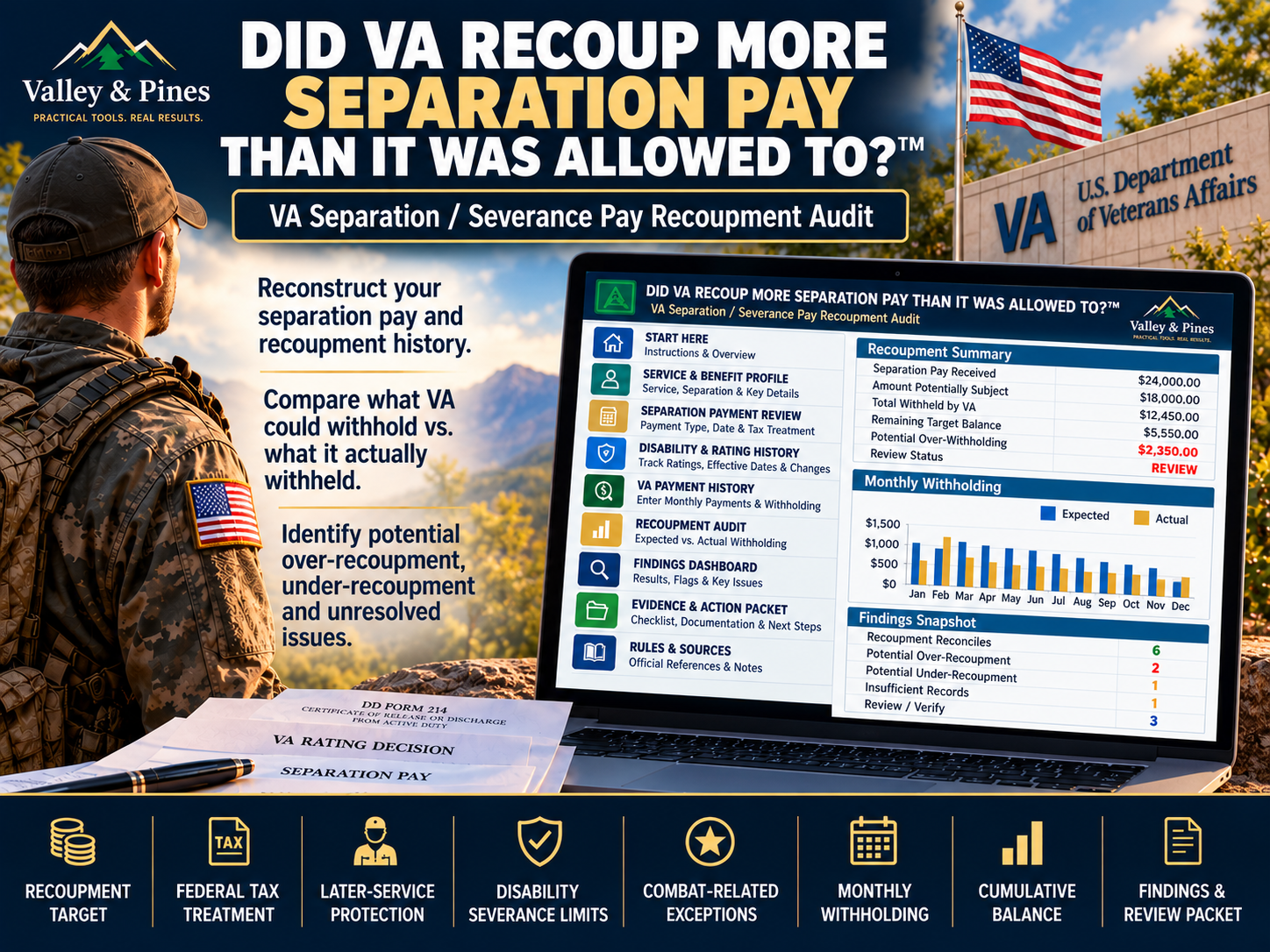
That is exactly what the Valley & Pines VA Separation / Severance Pay Recoupment Audit was built to help reconstruct.
The Excel workbook guides you through the benefit, tax, service, disability and payment history before comparing expected and actual withholding and tracking the remaining recoupment balance.
Your records remain with you.
The workbook runs locally in Microsoft Excel. Valley & Pines does not collect or store your military records, VA records, Social Security number, VA file number or banking information.
If the numbers do not reconcile, you have a clearer factual record showing exactly which payment, month, rule branch or missing document needs to be verified.
Reconstruct the record.
Follow the balance.
Find what does — or does not — reconcile.