
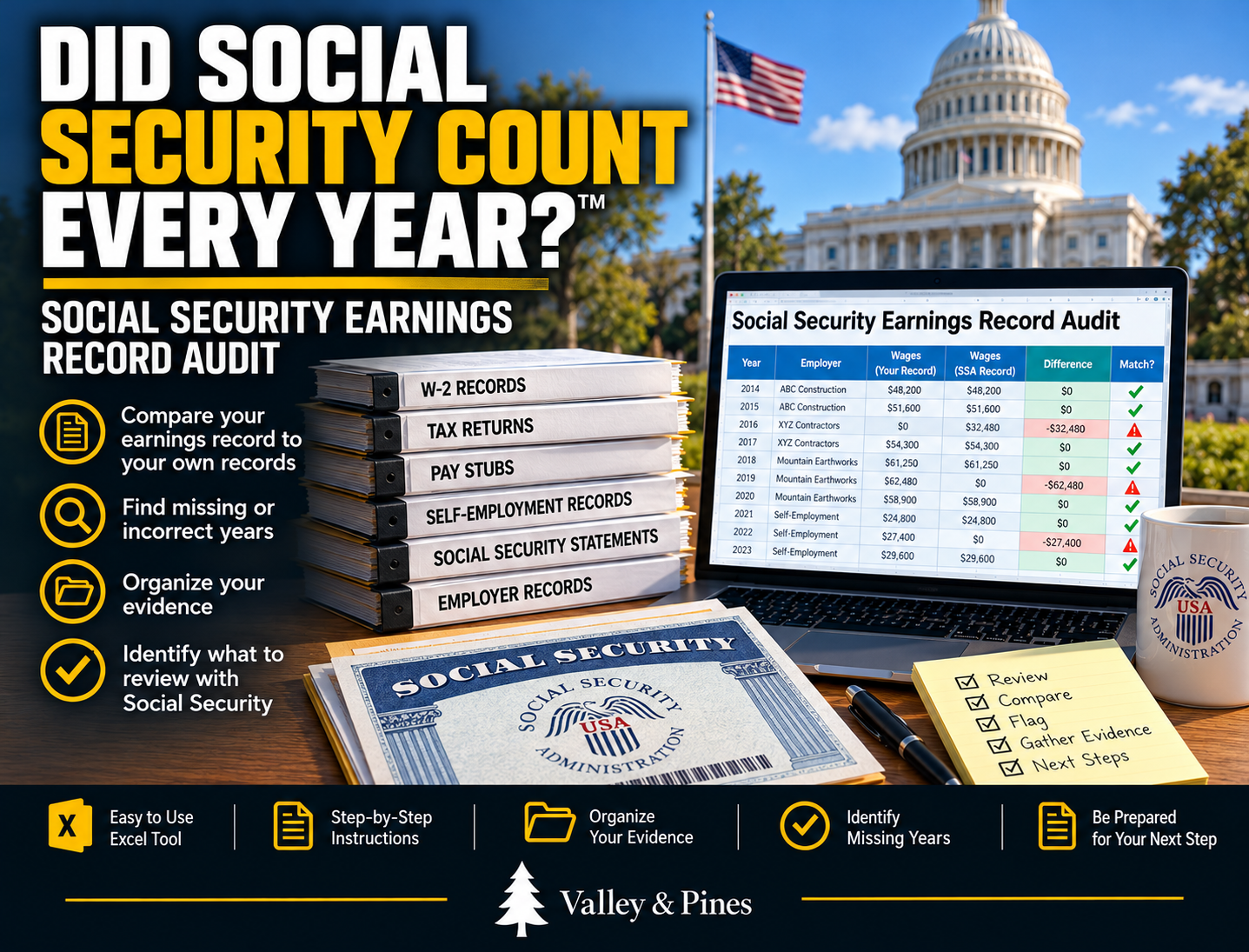
Your Social Security earnings record can span decades, making it easy for a missing or incorrect year to disappear inside a long Social Security earnings history. Reviewing that history year by year can help you identify wages or self-employment income that may be missing before those records affect future Social Security benefit calculations.
The Social Security Administration tells workers to review their earnings record because those earnings are used when calculating retirement and disability benefits.
Social Security records can also affect family benefits; if a student’s payments stopped at age 18, our guide to Social Security benefits for high school students explains when continued eligibility may still apply.
Think earnings are missing from your Social Security record?
Start by comparing each year on your Social Security earnings history against your W-2s, tax returns, pay stubs, employer records, and self-employment records. If a year or amount is missing or incorrect, gather the supporting evidence before requesting a correction.
Did Social Security count every year of earnings that should be on your record?
What to compare
Start with your Social Security earnings history and compare it with the records you already have.
Review each year for:
Employer
Year worked
Wages
Self-employment income, if applicable
W-2 information
Tax records
Pay records
Any name or Social Security number differences that may have affected reporting
A difference does not automatically mean the Social Security record is wrong.
Recent earnings may not appear immediately, and reporting issues can happen for several reasons.
The goal is to identify the years that deserve a closer look.
Why missing earnings matter
Your Social Security earnings history is used in determining future benefits.
If earnings are missing or reported incorrectly, the record may not fully reflect the wages or self-employment income you earned.
That is why reviewing the record year by year can be useful.
Instead of trying to answer whether your entire earnings history is correct, you can isolate a specific year and compare the Social Security amount against your own records.
Evidence matters
If you believe an earnings year is incorrect, supporting documentation is important.
SSA identifies records such as:
Forms W-2
Pay stubs
Tax returns
Employer records
Other documentation showing the earnings in question
SSA may allow some people to request an earnings correction online through their personal my Social Security account.
Other cases may require contacting Social Security directly or providing additional documentation.
Review the record systematically
DID SOCIAL SECURITY COUNT EVERY YEAR?™ is a Valley & Pines record-reconciliation tool designed to help you compare your own work and earnings history against the yearly earnings shown on your Social Security record.
It helps you:
Review your earnings record year by year
Compare reported earnings with your own records
Flag missing or inconsistent years
Identify supporting evidence
Create a clearer record of what may need follow-up
The workbook does not calculate Social Security benefits, determine eligibility, decide whether SSA owes additional benefits, or guarantee that an earnings correction will be accepted.
It is designed to help you identify which years deserve investigation before you contact Social Security.
If something does not reconcile
Do not assume every difference is an error.
Check the year involved, employer information, earnings records and supporting documentation first.
Keep in mind that the most recent earnings may not yet appear on your record.
If an older year still appears incorrect, follow the Social Security Administration's current official instructions for reviewing and correcting an earnings record.
The Social Security Administration remains the authoritative source for earnings records, corrections, eligibility and benefits.
Valley & Pines is not affiliated with, sponsored by, or endorsed by the Social Security Administration.