
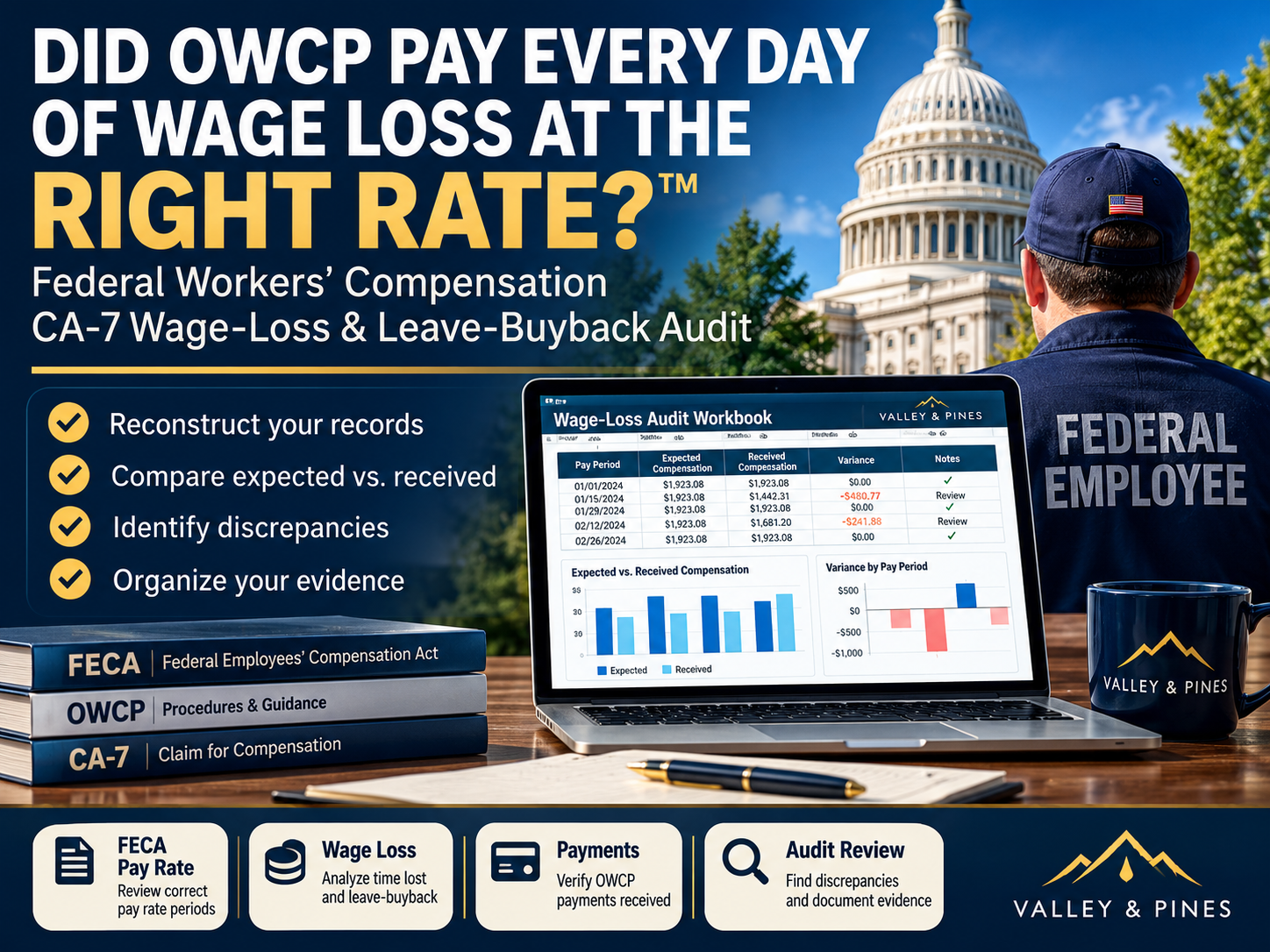
Did OWCP Pay Every Day of Wage Loss at the Right Rate?
A federal workers’ compensation payment can look straightforward on the surface: you submit wage-loss documentation, OWCP processes the claim, and compensation is issued.
But when you try to reconstruct what actually happened across multiple CA-7 periods, pay-rate changes, deductions, waiting periods and deposits, the record can become much harder to follow.
The question is not simply:
“Did I receive a payment?”
A more useful question is:
“Can I reconcile the accepted wage-loss record, the applicable compensation calculation and the payments I actually received?”
That requires looking at the entire record.
WHAT SHOULD YOU REVIEW IN AN OWCP WAGE-LOSS AUDIT?
A meaningful review may involve several different layers.
1. CA-7 AND CA-7a WAGE-LOSS PERIODS
Start with the time being claimed.
For each period, identify the dates, hours or days of wage loss reflected in the available records and compare them with the time that was actually accepted or paid.
The goal is not to assume that every difference is an OWCP error.
The goal is to identify where the records agree, where they do not, and where additional evidence may be needed.
2. YOUR FECA PAY-RATE HISTORY
A compensation calculation depends on the pay basis being used.
If your underlying pay record changed, or if different periods involve different circumstances, it can be important to reconstruct the historical pay information instead of relying only on the amount of a later payment.
Ordinary overtime, special pay situations and other pay components may require different treatment or further review.
3. THE COMPENSATION PERCENTAGE
FECA compensation may involve different percentage rates depending on the worker’s circumstances.
That makes it important to confirm which rate appears to have been applied during each relevant period rather than assuming the same percentage applied throughout the entire claim.
4. WAITING-PERIOD TREATMENT
Waiting-period rules can affect short periods of wage loss.
A good audit should separate days that were legitimately withheld under an applicable waiting rule from days that appear to be missing for some other reason.
Certain claim circumstances can also require additional review rather than a simple automatic conclusion.
5. CONTINUATION OF PAY
Continuation of Pay and OWCP wage-loss compensation are not the same thing.
If COP appears in the same overall timeline as compensation payments, the records need to be separated carefully so the same period is not accidentally treated as both unpaid and paid.
6. ACTUAL OWCP PAYMENTS
Do not stop at the gross compensation amount.
Record the payment period, gross amount, deductions, net payment and available deposit information.
Then compare the payment evidence with what the underlying wage-loss calculation indicates.
This can help surface:
• potential unpaid periods
• possible underpayments
• duplicate or overlapping records
• unexplained deduction differences
• missing payment documentation
• amounts that require further verification
7. LEAVE BUYBACK
Leave buyback can add another layer.
The useful question is not merely whether leave was restored.
You may need to reconcile the compensation attributable to the period, the agency calculation, the employee repayment amount and the leave that was ultimately restored.
If one part of that record is missing, the correct result may be “requires verification” rather than declaring an error.
8. RECURRENCE AND LATER WAGE LOSS
Later periods of disability or wage loss can raise additional timing and classification questions.
These periods should be documented separately and reviewed against the evidence actually available for that period.
MISSING EVIDENCE IS NOT THE SAME AS AN ERROR
This is one of the most important principles in a serious compensation audit.
If a payment statement, acceptance record, pay-rate document or other supporting record is missing, you may not yet have enough evidence to determine whether the amount was correct.
That is different from proving an underpayment.
A useful audit should therefore distinguish between:
MATCH
The records support the expected result.
POTENTIAL ISSUE
The available records show a difference that warrants closer review.
REQUIRES VERIFICATION
The available information raises a question, but another record or rule determination is needed.
INSUFFICIENT RECORDS
There is not enough evidence to reach a responsible conclusion.
That distinction matters.
It keeps the audit focused on evidence rather than assumptions.
BUILD ONE COMPLETE RECORD
Trying to reconstruct an OWCP claim from separate PDFs, emails, CA-7 forms, pay statements, agency records and bank deposits can quickly become difficult.
A better approach is to put the relevant information into one structured audit trail.
That is exactly why we created:
DID OWCP PAY EVERY DAY OF WAGE LOSS AT THE RIGHT RATE?™
Federal Workers’ Compensation CA-7 Wage-Loss & Leave-Buyback Audit
The Excel workbook helps you organize and review:
• Claim and pay information
• Historical FECA pay-rate data
• CA-7a time-loss periods
• OWCP payment records
• Deductions and net payments
• Waiting-period treatment
• Continuation of Pay
• Leave-buyback calculations
• Recurrence timing
• Potential discrepancies
• Missing evidence
• Questions requiring follow-up
It also creates a structured findings dashboard, discrepancy register, evidence checklist and review packet so the information is easier to work through.
The objective is not to manufacture a dispute.
It is to build a defensible record of what you know, what appears to match, what may not match and what you still need to verify.
REVIEW THE RECORD BEFORE YOU RELY ON THE TOTAL
A single payment total does not always tell the full story.
If you have multiple CA-7 periods, changing pay information, leave-buyback activity, deductions or incomplete payment documentation, reconstructing the record can make it much easier to understand what actually happened.
That gives you a stronger basis for deciding what questions — if any — need to be raised with OWCP or your employing agency.
Review the complete audit tool here:
DID OWCP PAY EVERY DAY OF WAGE LOSS AT THE RIGHT RATE?™
Federal Workers’ Compensation CA-7 Wage-Loss & Leave-Buyback Audit
Valley & Pines Publishing
This workbook is an independent record-audit and organizational tool. It does not determine legal entitlement, claim acceptance, medical eligibility or whether OWCP or an employing agency made a legal error.