
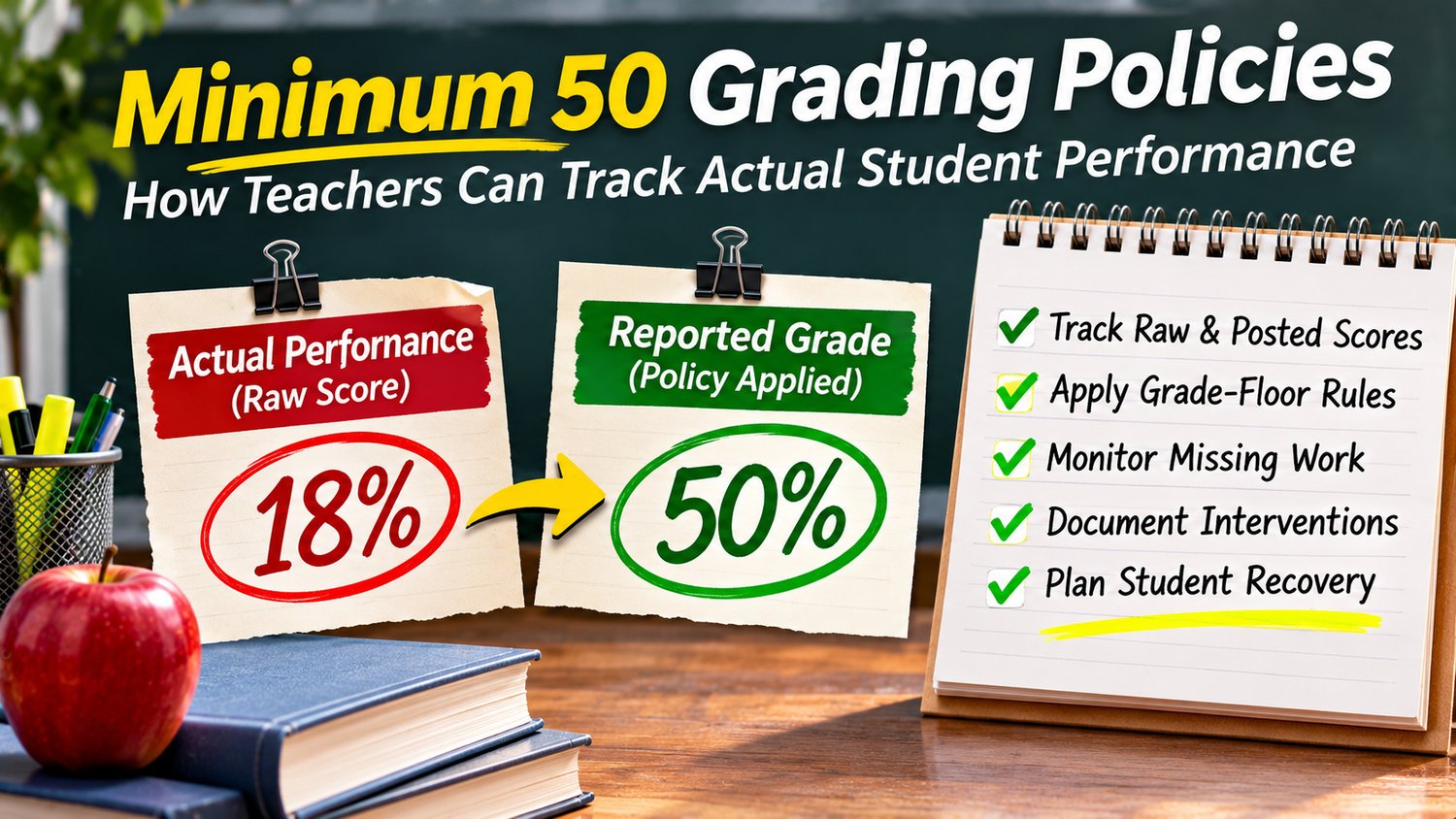
Minimum 50 Grading Policies: How Teachers Can Track Actual Student Performance
A student earns 18% on an assignment.
Under their school's minimum-grade policy, the gradebook displays 50%.
Which number tells the teacher what the student actually demonstrated?
Both numbers have a purpose, but they represent different information.
For teachers working under minimum-50, no-zero, or grade-floor policies, this distinction creates a practical documentation challenge.
How can teachers apply the grading rules required by their school while maintaining an accurate record of student performance, missing assignments, interventions, and recovery efforts?
The answer begins by separating demonstrated achievement from policy-adjusted grades.
WHAT IS A MINIMUM 50 GRADING POLICY?
Some schools use policies that establish a minimum recorded grade, often 50%, for qualifying assignments or grading periods.
The details vary considerably.
A policy might apply to attempted work, missing assignments, particular categories, or the overall grading-period average.
Other policies may specify reassessment requirements, late-work treatment, or exceptions.
There is no single universal minimum-50 rule.
Teachers must use the actual policy governing their school or classroom.
THE PROBLEM WITH TRACKING ONLY THE POSTED GRADE
Consider a hypothetical grading policy that requires qualifying scores below 50% to be posted as 50%.
Three students complete an assignment:
Student A earns 18%.
Student B earns 39%.
Student C earns 49%.
Under this example policy, all three assignments might display 50% in the official gradebook.
But those students demonstrated different levels of understanding.
If the teacher keeps only the adjusted scores, important information about their performance may become harder to retrieve.
This can complicate intervention planning, parent conferences, progress monitoring, and instructional decisions.
KEEP RAW SCORES AND POSTED SCORES SEPARATE
An effective tracking system should distinguish three things.
RAW SCORE
The score the student actually earned.
POSTED SCORE
The grade recorded after applying the applicable policy.
POLICY GAP
The difference between the demonstrated score and the policy-adjusted score.
For example:
Raw score: 32%.
Policy-adjusted score: 50%.
Policy gap: 18 percentage points.
This information helps teachers preserve the original performance evidence while complying with applicable grading rules.
It does not determine which grading policy should be used.
TRACK MISSING WORK AND ATTEMPTED WORK DIFFERENTLY
Some grading policies treat missing assignments differently from work that a student attempted.
That distinction can be important.
A student who completed an assignment but demonstrated limited mastery may need a different intervention from a student who never submitted the work.
A useful documentation system can distinguish:
Missing work.
Attempted work.
Late submissions.
Below-mastery performance.
Reassessment opportunities.
Recovery work.
Completed interventions.
Teachers can then apply the correct policy treatment while maintaining a useful record of the underlying circumstances.
USE THE DATA TO IDENTIFY NEXT STEPS
Preserving demonstrated scores is only valuable if teachers can use that information.
Suppose a student has several assignments displaying the same policy-adjusted grade.
The original performance records may show that one assignment was nearly mastered while another revealed substantial misunderstanding.
That difference can help teachers identify appropriate review activities, reassessments, and recovery opportunities.
The objective is not simply to calculate grades.
It is to determine which learning needs require attention.
DOCUMENT INTERVENTIONS AND COMMUNICATION
Grade reporting can become complicated during parent conferences, intervention meetings, or administrative reviews.
Teachers may be asked:
What did the student actually earn?
How was the reported grade calculated?
Which assignments are missing?
What interventions have been provided?
Has the student completed reassessment or recovery work?
What should happen next?
Maintaining a consistent record can make these conversations clearer and more productive.
Any student records must be handled according to the school's approved privacy and data-management requirements.
CREATE A STUDENT-FACING RECOVERY PLAN
Students benefit from understanding what they need to do next.
A practical recovery summary might identify:
Current reported grade.
Assignments requiring attention.
Evidence of demonstrated performance.
Available reassessment opportunities.
Eligible recovery work.
Upcoming deadlines.
Next recommended actions.
The teacher remains responsible for determining eligibility, applying grading policies, and making instructional decisions.
The tracking system simply helps organize the information.
WHY A NORMAL GRADEBOOK MAY NOT BE ENOUGH
A school's official gradebook is designed to record and report grades according to established rules.
It may not provide a convenient separate view of raw scores, policy-adjusted scores, intervention history, and individual recovery decisions.
Teachers sometimes need an additional documentation tool for those purposes.
The important requirement is that any supplemental system be consistent with school policies and approved student-information procedures.
A CONFIGURABLE MINIMUM 50 GRADE TRACKER
Valley & Pines Publishing developed GRADE FLOOR SURVIVAL SYSTEM™, a Minimum 50 Grade Tracker and Recovery Dashboard for teachers working under grade-floor or no-zero policies.
This Excel-based system allows teachers to enter the applicable rules and track both demonstrated performance and policy-adjusted grades.
The system supports configurable grade floors such as 50, 55, 60, or a custom threshold.
It also includes settings for missing work, attempted assignments, late work, reassessment, and recovery treatment.
The resource contains a 14-tab Excel system with teacher support materials.
Key features include:
Raw and posted grade tracking.
Policy-adjustment calculations.
Grade-floor configuration.
Student recovery dashboards.
Missing-work and below-mastery evidence.
Intervention and contact logs.
Parent-conference reporting.
Administrative documentation summaries.
Student-facing recovery views.
Built-in calculation testing.
Teachers configure the rules that apply in their own setting. The workbook does not interpret school policy or determine legal requirements.
WHO CAN BENEFIT FROM THIS TOOL?
The tracker is intended for Grades 6–12 and can support teachers across subject areas.
It may be particularly useful for educators responsible for documenting academic interventions, student progress, grade recovery, and communication under minimum-grade policies.
The objective is to maintain clear evidence while reducing repetitive administrative calculations.
EXPLORE THE MINIMUM 50 GRADE TRACKER
GRADE FLOOR SURVIVAL SYSTEM™ — Minimum 50 Grade Tracker | No-Zero Policy Evidence & Recovery Dashboard
Available on Teachers Pay Teachers for $16.99 USD.
DIRECT PRODUCT LINK:
https://www.teacherspayteachers.com/Product/Minimum-50-Grade-Tracker-No-Zero-Policy-Evidence-Recovery-Dashboard-17858667
The resource includes Microsoft Excel, editable teacher instructions, and a printable quick-reference guide.
FOLLOW THE POLICY. PRESERVE THE EVIDENCE.
Whether a teacher supports or questions a particular grading approach, the practical responsibility remains the same: apply the policy that governs their classroom and maintain reliable records.
A policy-adjusted grade and a student's demonstrated performance are not necessarily identical.
Keeping both visible can support more accurate conversations, clearer intervention plans, and better documentation.
That's the purpose of a configurable grade-floor tracking system: not to decide what the policy should be, but to help teachers manage the policy they have.