
How to Help Failing Students Recover Their Grades Before the Deadline
A student approaches their teacher near the end of a grading period and asks a familiar question:
"What do I need to do to pass?"
The usual answer might be to complete all missing assignments, attend extra help sessions, or submit as much work as possible.
But what if completing everything isn't necessary?
Or worse, what if completing every remaining eligible assignment still wouldn't produce a passing grade?
Grade recovery becomes much more productive when teachers and students understand what is mathematically possible.
Instead of relying on guesswork, teachers can identify a realistic path based on the student's current grade, the work that remains eligible, and the applicable grading rules.
WHY TRADITIONAL GRADE RECOVERY PLANS SOMETIMES FAIL
A student may have ten missing assignments, but those assignments don't necessarily contribute equally to the final grade.
Some may have low point values.
Others may be worth substantially more.
Certain assignments may no longer be eligible for recovery.
Late-work caps or reassessment limits may reduce the maximum score available.
And some grading systems use weighted categories, meaning the impact of an assignment depends on more than its individual point value.
Asking students to complete every missing assignment without examining these factors can produce a lot of effort without a clear understanding of the likely outcome.
START WITH THE CURRENT GRADE AND TARGET
Before developing a recovery plan, establish two things:
The student's current calculated grade.
The grade required to reach their target.
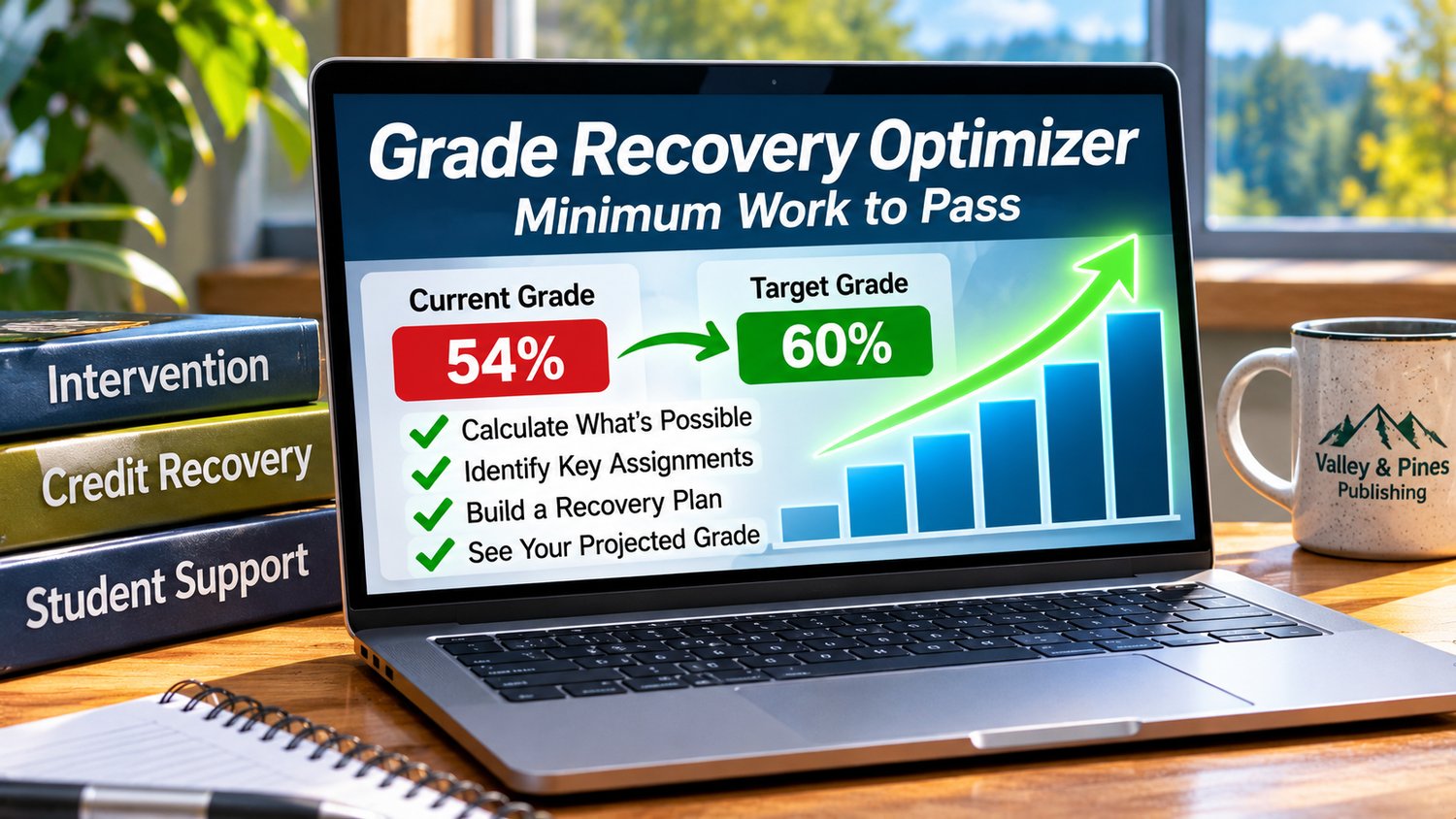
For example, a student currently earning 54% might need 60% to pass under a hypothetical school policy.
That six-percentage-point gap tells us how much improvement is needed, but not how many assignments must be completed.
The actual calculation depends on how the course grade is determined and which recovery opportunities remain available.
IDENTIFY WHICH ASSIGNMENTS ARE STILL ELIGIBLE
Not every missing assignment necessarily belongs in a recovery calculation.
Teachers should first determine what work may still be submitted, reassessed, corrected, or otherwise recovered under applicable policies.
This might include:
Missing assignments still eligible for submission.
Reassessments permitted under school rules.
Assignments with teacher-approved extensions.
Work subject to late-credit limits.
Other qualifying recovery opportunities.
The key is to distinguish between assignments that exist in the gradebook and assignments that can still change the student's grade.
CALCULATE THE MAXIMUM ACHIEVABLE GRADE
This is one of the most important steps.
Before telling a student that passing is possible, determine the highest grade the student could mathematically reach using the available recovery opportunities.
For example, a student may need 65% to reach their target.
But after accounting for all eligible work and applicable score limits, their maximum possible grade might be only 62%.
That doesn't mean the student should stop learning or completing appropriate work.
It means the current recovery opportunities cannot mathematically produce the selected target.
Teachers can use that information to have an accurate conversation about available options rather than promising a result that the calculations cannot support.
FIND THE SMALLEST VIABLE RECOVERY PATH
When the target is achievable, the next question becomes:
Which combination of eligible assignments could reach it?
Imagine a student has six recovery opportunities.
Some carry greater grade impact than others.
Completing two high-impact assignments might produce a viable path to the target, while several lower-impact assignments would not.
Rather than assigning every task without distinction, teachers can evaluate combinations of eligible work to identify a mathematically efficient recovery plan.
The selected path should still account for instructional value, school rules, required learning, and the student's individual circumstances.
The smallest viable set of assignments is a planning tool, not permission to disregard required coursework.
BUILD A STUDENT-FACING RECOVERY PLAN
Students need more than a list of assignments.
A useful recovery summary should communicate:
Current grade.
Target grade.
Maximum achievable grade.
Assignments included in the recovery plan.
Applicable deadlines.
Estimated grade if the specified scores are achieved.
The next action the student should take.
A clear plan can make teacher-student conferences more focused and give students realistic expectations about the work ahead.
PRIORITIZE STUDENTS WHO NEED SUPPORT
For teachers managing several classes, grade recovery can become a whole-class intervention challenge.
Different students may require different responses.
Some students are already meeting their target.
Some have a reachable target with only one or two eligible assignments.
Others need a more extensive recovery plan.
Some cannot currently reach the selected target using the work still available.
Separating these situations helps teachers decide where to concentrate recovery conversations, academic support, and follow-up.
AVOID PROMISING A GRADE THAT ISN'T GUARANTEED
Even a mathematically valid recovery plan does not guarantee a passing grade.
A projected outcome depends on the scores actually earned.
If a plan assumes a student will receive 90% on an assignment but they earn 65%, the final result will differ.
That's why recovery projections should be presented as conditional estimates rather than guaranteed outcomes.
Teachers must also continue applying their school's grading policies, accommodations, and other student-specific requirements.
AUTOMATE THE RECOVERY CALCULATIONS WITH EXCEL
Calculating recovery possibilities individually can become time-consuming, especially when teachers must account for different grade targets, weighted categories, late-work caps, and multiple assignments.
Valley & Pines Publishing developed WHAT CAN I DO TO PASS?™, the Grade Recovery Optimizer, to help teachers perform these calculations.
This Microsoft Excel workbook allows teachers to enter their applicable grading rules, identify eligible assignments, and calculate realistic recovery possibilities.
The system includes:
Current grade and target-grade calculations.
Maximum mathematically achievable grade.
Reachability checks.
Minimum eligible-assignment recovery paths.
Projected grade calculations.
Alternate recovery paths when available.
A target ladder showing different possible grade outcomes.
Whole-class intervention triage.
Individual student recovery summaries.
The workbook supports total-points and weighted-category grading.
It contains 10 organized sheets and supports up to 40 students and 400 recovery-work entries. The optimizer analyzes up to 25 eligible recovery assignments per student at once, with a warning if that limit is exceeded.
Teachers determine which work is eligible and which grading rules apply. The workbook performs the mathematical analysis using those inputs.
A CLEARER ANSWER TO "WHAT DO I NEED TO PASS?"
Grade recovery shouldn't depend on guesswork.
When a student asks what they need to do, teachers can provide a more useful answer by identifying what's possible, which assignments matter, and what work remains.
The objective is to create a realistic academic recovery plan that supports informed decisions and meaningful student effort.
EXPLORE THE GRADE RECOVERY OPTIMIZER
WHAT CAN I DO TO PASS?™ — Grade Recovery Optimizer | Minimum Work to Pass | Student Intervention Tracker
Available for $14.99 USD on Teachers Pay Teachers.
DIRECT PRODUCT LINK:
https://www.teacherspayteachers.com/Product/Grade-Recovery-Optimizer-Minimum-Work-to-Pass-Student-Intervention-Tracker-17861173
The resource is designed for Microsoft Excel and Grades 6–12.
It does not determine school grading policies or guarantee that a student will earn the projected grade.
HELP STUDENTS FOCUS ON A REALISTIC NEXT STEP
Students facing failing grades often need more than encouragement to work harder.
They need clarity.
A good recovery plan identifies what is possible, explains what actions could make a difference, and creates a manageable path forward.
When teachers can separate achievable targets from unrealistic expectations, grade-recovery conversations become more transparent and productive.
The goal is not simply to complete more assignments.
It's to make informed recovery decisions while keeping the focus on student learning.