
A student is struggling with fractions.
Do you reteach fractions?
Maybe.
But what if the real problem is multiplication fluency? Place value? Equivalent fractions? Division? Understanding part-whole relationships?
That is the problem with many math interventions: the visible struggle is not always the actual learning gap.
The Hardest Question Is Often: What Do I Teach Them Now?
Teachers regularly encounter students who cannot successfully access the current grade-level lesson.
The obvious response is to provide additional practice.
But more practice on the wrong skill does not necessarily solve the problem.
Before deciding what to reteach, a teacher needs to know:
Where did the learning chain actually break?
Which prerequisite skill is missing?
Is the student misunderstanding the concept or simply making procedural errors?
What should be taught first?
When is the student ready to return to grade-level work?
That is the job WHAT DO I TEACH THEM NOW?™ was built to handle.
A Math Learning Gap Is Usually a Chain, Not a Single Skill
Math is cumulative.
Later skills depend on earlier ones.
A student struggling with percentages may actually have a weakness in decimal relationships.
A student struggling with equations may be missing integer operations.
A student struggling with fraction operations may have an earlier multiplication or division gap.
If intervention begins only at the point where the student is currently failing, the underlying problem can remain untouched.
The goal should be to identify the first meaningful break in the prerequisite chain.
Then intervention becomes targeted instead of random.
A Structured Find → Verify → Repair → Return Process
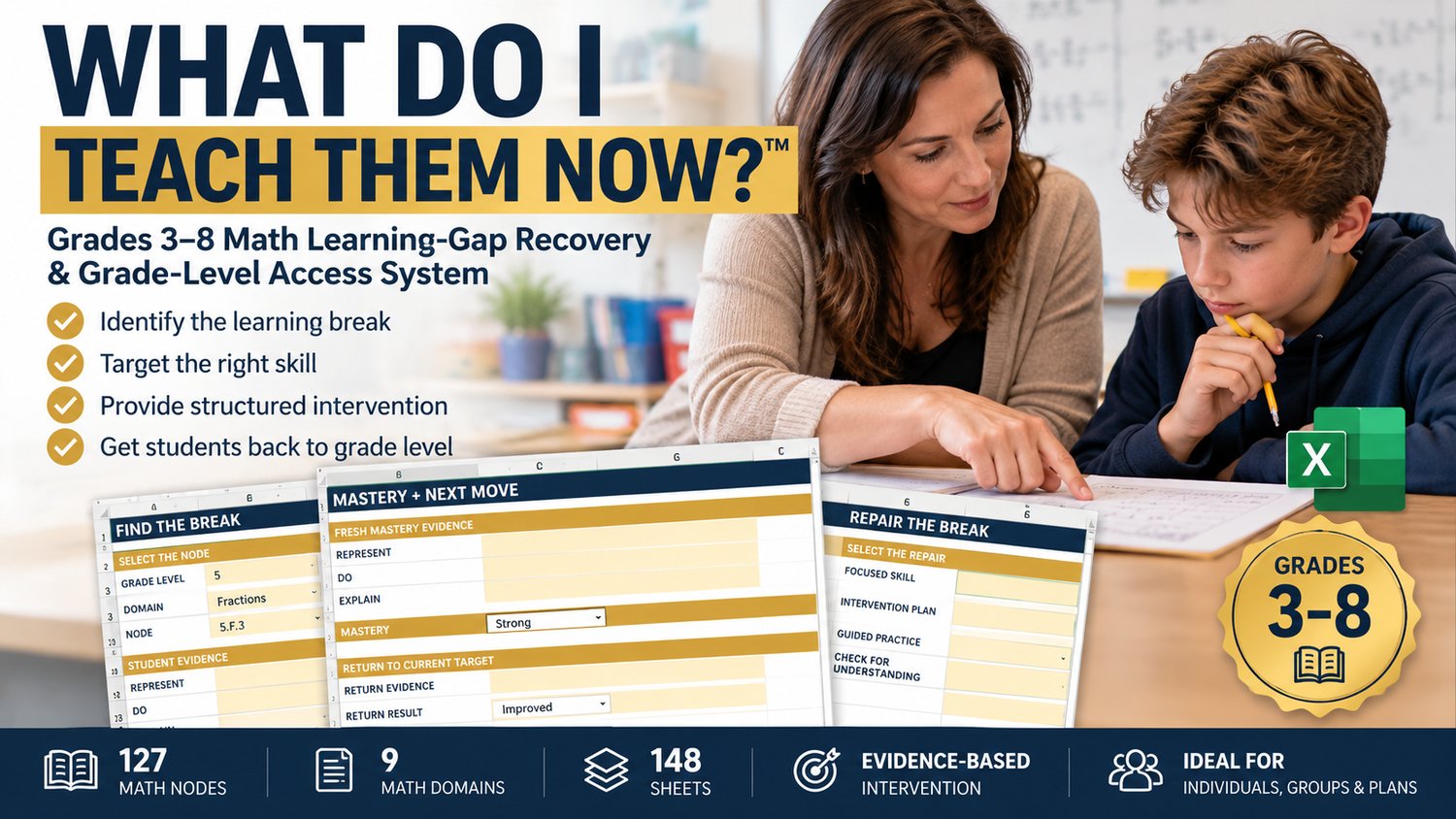
WHAT DO I TEACH THEM NOW?™ is a teacher-facing Excel system designed around a straightforward intervention workflow.
Teachers can:
FIND the likely blocker.
VERIFY whether the student actually understands the prerequisite skill.
BRIDGE the gap between the missing skill and the current target.
REPAIR the identified learning break.
PRACTICE the repaired skill.
MASTER it using fresh evidence.
RETURN the student to the original grade-level target.
DECIDE what should happen next.
Instead of simply recording that a student is “behind,” the system helps answer a much more useful question:
What exactly should I teach this student next?
127 Instructional Math Nodes Across Grades 3–8
The system contains 127 instructional math nodes organized across nine major mathematical domains:
Foundations
Whole Numbers
Multiplication & Division
Fractions
Decimals
Ratio, Rate & Percent
Integers & Rational Numbers
Expressions, Equations & Linear Thinking
Geometry & Measurement
Each node is designed to help a teacher examine student evidence, identify the instructional break, provide targeted intervention, and determine whether the learner is ready to move forward.
The complete workbook contains 148 sheets.
Built for Evidence, Not Guesswork
One of the most important differences between structured intervention and ordinary extra practice is the use of fresh evidence.
The system prompts teachers to look at what the student can REPRESENT, DO, and EXPLAIN.
That matters because a student who can imitate a procedure is not necessarily demonstrating conceptual understanding.
After intervention, teachers collect fresh mastery evidence and determine whether performance is Strong, Mixed, or Weak.
The student can then be returned to the original grade-level target and the teacher can record whether performance Improved, Partially Improved, or remained Unchanged.
That creates a much clearer intervention loop.
Designed for Real Teacher Workflow
This is not a 148-page worksheet packet.
It is a teacher decision and intervention system.
The workbook is structured so teachers can move from identifying a problem to selecting an instructional response without having to construct an intervention pathway from scratch.
Input areas are clearly identified, workflow directions are built into the workbook, and protected sheets help prevent accidental changes to the underlying system.
The result is a reusable framework that can support individual students, intervention groups, special education planning, tutoring, homeschool instruction, and broader math support programs.
When a Student Is Behind, Start With the Break
The most useful intervention question is often not:
“What grade level is this student working at?”
It is:
“What prerequisite skill is preventing this student from doing the work in front of them?”
Find that break.
Repair it.
Verify the repair.
Then reconnect the student to grade-level mathematics.
Stop guessing. Identify the gap. Teach the right skill. Get them back on track.