
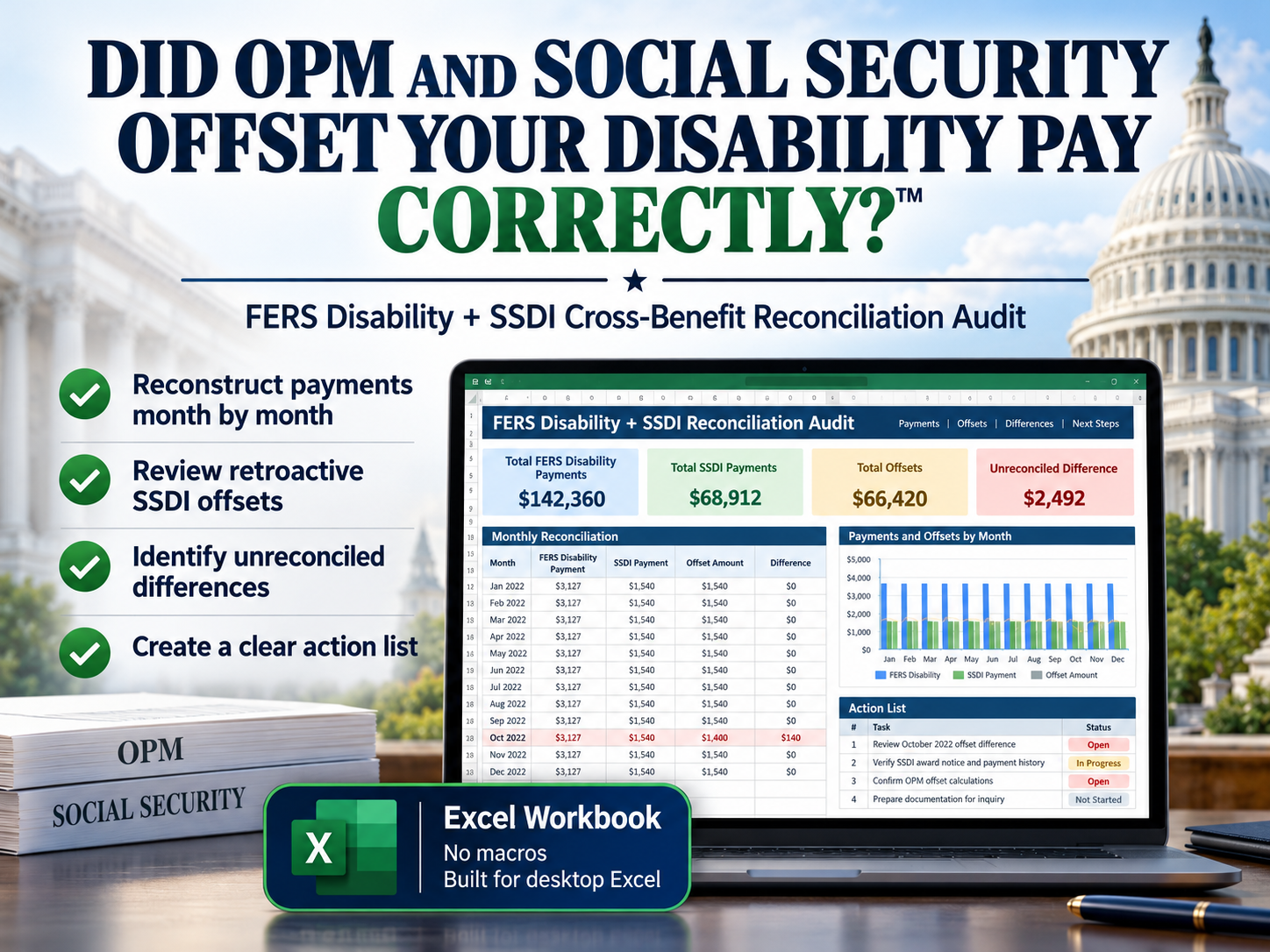
DID OPM AND SOCIAL SECURITY OFFSET YOUR DISABILITY PAY CORRECTLY?™
How FERS Disability and SSDI Can Overlap — and Why the Math May Need a Month-by-Month Review
If you receive FERS disability retirement and are later approved for Social Security Disability Insurance, the interaction between the two benefits can become complicated very quickly.
The issue becomes even harder when SSDI is approved retroactively.
You may receive an SSA decision months after your SSDI entitlement actually began. Meanwhile, OPM may already have paid FERS disability benefits for some or all of those same months.
That can lead to recalculations, adjustments, recovery notices and one very important question:
Did OPM apply the SSDI offset correctly for every affected month?
WHY THE SSDI ENTITLEMENT DATE MATTERS
One of the easiest dates to misunderstand is the SSDI approval date.
The date Social Security approves your claim is not necessarily the same date that matters when reviewing the interaction with FERS disability retirement.
Your official SSDI entitlement period may begin earlier.
If SSDI is later awarded retroactively, earlier FERS disability payments may need to be reviewed because the two benefits overlapped during those months.
That means a simple comparison of annual totals may not tell you much.
The review often needs to happen month by month.
THE FERS DISABILITY FORMULA CAN ALSO CHANGE
FERS disability retirement does not necessarily use the same calculation throughout the entire pre-age-62 period.
Different stages of the disability retirement period can involve different calculations and different treatment of SSDI.
That makes timing critical.
A review may need to determine:
• Which FERS disability phase applied during each month
• Whether SSDI entitlement existed during that month
• What SSDI amount applied
• What gross FERS disability amount was expected
• What gross amount OPM actually paid
• Whether an OPM adjustment or recovery was later applied
• Whether the available records fully explain the difference
RETROACTIVE SSDI CAN MAKE THE RECORDS HARD TO FOLLOW
Imagine that OPM has already been paying FERS disability retirement.
Later, Social Security approves SSDI and establishes an entitlement date several months earlier.
The SSDI payment may arrive as a large retroactive deposit.
OPM may then adjust the FERS disability benefit or attempt to recover amounts associated with the overlapping months.
The problem for the retiree is that the transactions do not always arrive in a neat month-by-month format.
A large OPM adjustment may cover several earlier months.
A Social Security payment may represent months of retroactive benefits.
Benefit rates may also change during the period being reviewed.
Without reconstructing the timeline, it can be very difficult to determine what happened.
GROSS PAYMENT VERSUS WHAT HIT YOUR BANK ACCOUNT
Another source of confusion is comparing the wrong numbers.
Your bank deposit is generally a net amount.
It may already reflect taxes, FEHB premiums, FEGLI premiums and other documented deductions.
But when reviewing whether the underlying FERS disability calculation reconciles, the important comparison is generally between the expected gross benefit and the gross amount recorded by OPM.
Mixing gross benefit calculations with net bank deposits can create apparent discrepancies that are actually just deductions.
WHEN THE RECORDS DO NOT LINE UP
A discrepancy does not automatically mean OPM or Social Security made an error.
It may mean another record is needed.
For example, a review could uncover:
• A missing OPM monthly payment record
• A missing SSA benefit amount
• An SSDI rate change
• A retroactive adjustment that has not been allocated by month
• A first-year versus later-period calculation issue
• An unclear earned-annuity floor
• A benefit suspension or restart
• An age-62 recomputation issue
• Conflicting entitlement dates
Those situations should not be forced into a simple MATCH or ERROR result.
They need to be isolated and reviewed against the official agency records.
A MONTH-BY-MONTH AUDIT CAN MAKE THE HISTORY MUCH CLEARER
That is why we created:
DID OPM AND SOCIAL SECURITY OFFSET YOUR DISABILITY PAY CORRECTLY?™
The FERS Disability + SSDI Cross-Benefit Reconciliation Audit is an Excel workbook designed to help you organize your official OPM and SSA records and reconstruct the affected period month by month.
It helps you compare expected FERS disability payments against recorded OPM gross payments, review SSDI overlap periods, track retroactive adjustments and identify months that still require explanation.
The workbook includes:
• Case Setup
• OPM Disability Award records
• SSDI History
• OPM Payment History
• Expected FERS Disability calculations
• Retroactive SSDI Reconciliation
• Exceptions & Action List
• Audit Summary
The purpose is not to determine whether you qualify for disability benefits.
Official OPM and Social Security decisions are treated as inputs.
The objective is to determine whether the payment history you have appears to reconcile with those official decisions — and to clearly identify the months and records that deserve another look.
PRIVACY-FIRST
The workbook does not require your Social Security number, CSA number, bank account number, full address, medical diagnosis, medical records or SSA claim number.
Your records stay with you.
READY TO REVIEW YOUR FERS DISABILITY AND SSDI HISTORY?
If you received FERS disability retirement and SSDI — particularly if your SSDI award was retroactive or OPM later made an adjustment — reconstructing the overlap month by month can help turn a confusing stack of agency records into a much clearer timeline.
Use the FERS Disability + SSDI Cross-Benefit Reconciliation Audit to organize the records, identify unresolved months and prepare more specific questions for OPM and/or the Social Security Administration.
Digital Excel workbook. No macros. No VBA. Built for desktop Microsoft Excel.
This workbook is an audit and reconciliation tool and does not provide legal, medical, tax or benefits-representation advice. It does not determine eligibility for FERS disability retirement or SSDI and does not state that OPM or SSA owes any particular amount.