
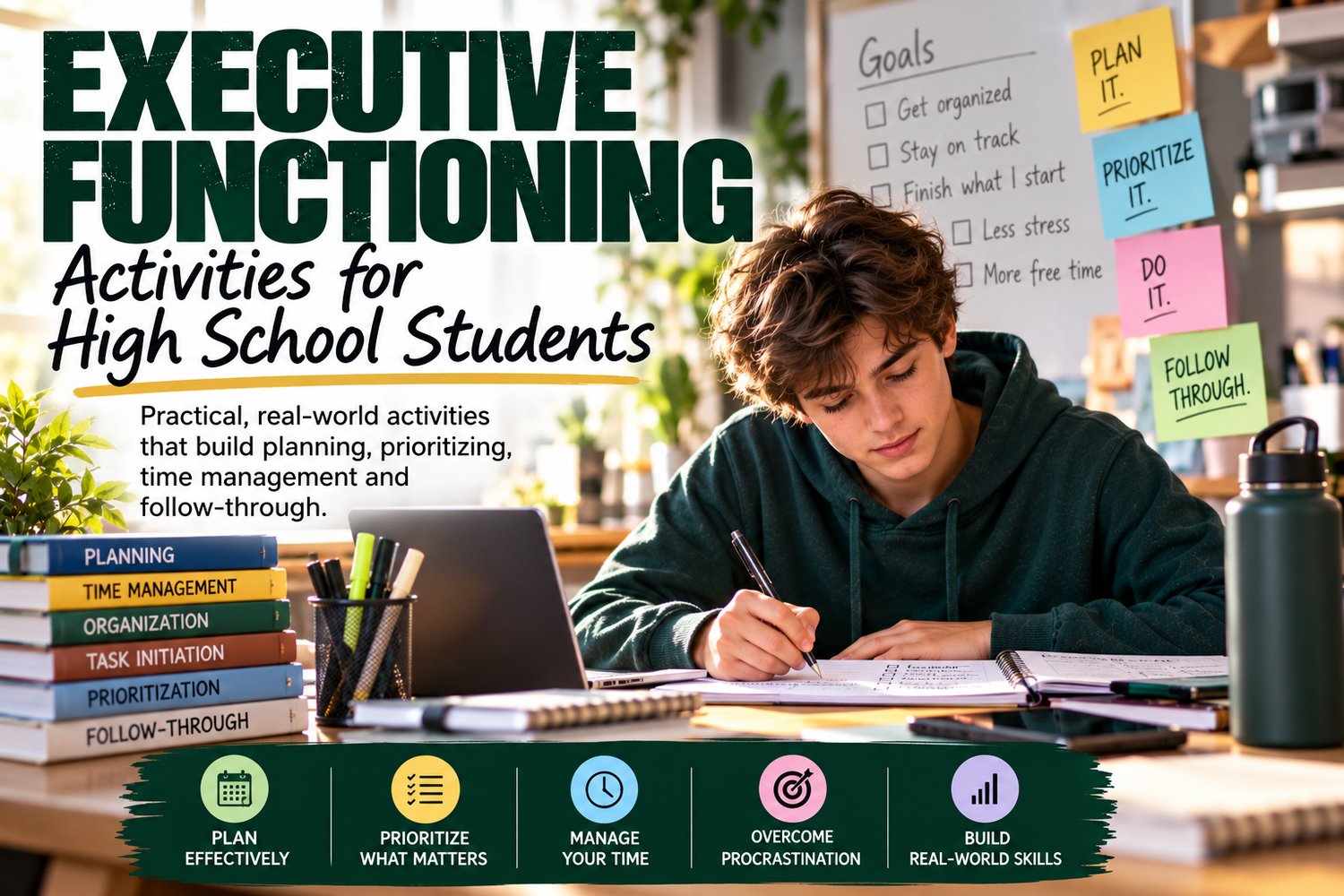
EXECUTIVE FUNCTIONING ACTIVITIES FOR HIGH SCHOOL STUDENTS
A high school student can be intelligent, capable and completely aware of what needs to be done—and still struggle to get the work finished.
The assignment is written down.
The deadline is known.
The student even intends to do it.
Then the afternoon disappears.
That is why executive functioning instruction needs to go beyond telling students to “get organized,” “manage your time” or “try harder.”
Students need opportunities to practise the actual decisions behind those skills.
WHAT ARE EXECUTIVE FUNCTIONING SKILLS?
Executive functioning is not one single ability.
It includes several skills students use to manage responsibilities and move toward a goal.
These may include:
Task initiation
Planning
Prioritizing
Time management
Organization
Working memory
Self-monitoring
Flexible thinking
Goal setting
Managing distractions
Following through
Problem solving
A student may be strong in one area and struggle significantly in another.
For example, a student may remember every assignment but underestimate how long each one will take.
Another student may build an excellent plan but struggle to begin.
A third may start quickly but lose track of materials or deadlines.
That is why effective executive-function instruction should help students identify the specific point where their system is breaking down.
ACTIVITY 1: FIND THE REAL FIRST STEP
Give students a large task such as:
Write a research paper.
Apply for a summer job.
Study for the final exam.
Clean and organize your room.
Catch up on missing assignments.
Then ask:
What is the first action you could physically do?
Not:
“Work on the project.”
Instead:
“Open the assignment instructions.”
Not:
“Apply for jobs.”
Instead:
“Find three jobs that are currently hiring.”
Students learn that a task becomes easier to start when the first move is specific.
This activity develops task initiation and planning.
ACTIVITY 2: PRIORITIZE COMPETING RESPONSIBILITIES
Give students a realistic list:
Math assignment due tomorrow
English project due Friday
Shift at work tonight
Friend asking for help
Science quiz in two days
Three missing assignments
Laundry
College application deadline next week
Ask students to rank what they would do first.
Then ask the more important question:
Why?
There may not be one perfect order.
Students need to consider:
Urgency
Importance
Consequences
Time required
Deadlines
Dependencies
Available time
This teaches students that prioritizing is not simply doing whatever is due first.
It is making deliberate decisions when several things compete for attention.
ACTIVITY 3: ESTIMATE THE TIME
Give students common tasks and have them estimate how long each will take.
Then compare those estimates with actual completion times.
Examples:
Read ten pages
Complete ten math questions
Write one paragraph
Respond to an email
Study vocabulary
Prepare lunch
Complete a job application
Clean a bedroom
Students often build impossible schedules because they underestimate the time required.
Developing better time awareness makes planning more realistic.
ACTIVITY 4: BREAK DOWN A LARGE ASSIGNMENT
Choose a project students understand.
For example:
Complete a five-page research paper.
Ask students to break it into smaller actions.
A possible sequence might be:
Read instructions
Choose topic
Find sources
Take notes
Create outline
Write introduction
Draft body paragraphs
Write conclusion
Add citations
Edit
Proofread
Submit
Then ask:
Which steps can happen in one work session?
Which steps depend on something else being finished first?
Which step should happen today?
Large tasks become more manageable when students stop viewing them as one enormous responsibility.
ACTIVITY 5: BUILD A DISTRACTION PLAN
Instead of telling students to “focus,” ask them what normally interrupts their work.
Possible answers may include:
Phone
Notifications
Friends
Games
Noise
Other browser tabs
Television
Hunger
Being unsure what to do
Thinking about another responsibility
Then ask students to build a plan for one focused work period.
For example:
Phone in another room.
Only required tabs open.
Water and materials ready.
Twenty-minute work timer.
First action identified before starting.
Students learn that focus is partly about managing the environment before distraction happens.
ACTIVITY 6: PRACTISE TASK INITIATION
Give students a task they are likely to avoid.
Ask them to identify:
What makes this difficult to start?
What is the smallest useful first action?
What materials need to be ready?
What could remove friction?
Could they commit to a ten-minute launch?
The objective is not necessarily to finish the task.
The objective is to practise crossing the starting line.
This is especially useful for students who repeatedly know what they should do but cannot seem to begin.
ACTIVITY 7: SORT MISSING WORK
Give students a fictional grade portal containing several missing assignments.
Have them decide:
Which assignments should be addressed first?
Which can still be submitted?
Which have the greatest grade impact?
Which are quick wins?
Which require teacher clarification?
Which may no longer be worth completing?
Students learn to move from emotional overwhelm to structured decision-making.
This is executive functioning in a very practical form.
ACTIVITY 8: PLAN A REALISTIC AFTER-SCHOOL SCHEDULE
Give students a scenario:
School ends at 3:00.
Bus arrives home at 3:40.
Work shift begins at 6:00.
Math assignment takes approximately 45 minutes.
Science quiz tomorrow.
Student also needs dinner and travel time.
Ask them to design the evening.
Then introduce a disruption:
The bus is twenty minutes late.
What changes?
This builds planning and flexible thinking.
The first schedule matters.
The ability to revise it matters even more.
ACTIVITY 9: USE AN URGENT-VERSUS-IMPORTANT MATRIX
Students often react to whatever feels most immediate.
Teach them to separate:
Urgent and important
Important but not urgent
Urgent but less important
Neither urgent nor important
Then give them realistic examples.
Studying for tomorrow's exam may be urgent and important.
Beginning a major project due in two weeks may be important but not urgent.
Responding immediately to every phone notification may feel urgent while being relatively unimportant.
Students begin seeing how attention can be hijacked by urgency.
ACTIVITY 10: CREATE A WEEKLY RESET
Teach students to use a short weekly review.
Ask them to check:
What is due next week?
What is missing?
What major deadlines are approaching?
What appointments, practices or shifts affect available time?
What materials are needed?
What should be started before it becomes urgent?
A weekly reset can prevent small problems from becoming large recovery projects.
ACTIVITY 11: PRACTISE RECOVERY WHEN THE PLAN FAILS
Executive functioning instruction should not assume students will follow every plan perfectly.
Give students a scenario:
You planned to complete three assignments Tuesday night.
You only finished one.
What now?
Students might:
Recalculate available time
Identify the highest priority remaining task
Move lower-priority work
Contact a teacher if necessary
Adjust tomorrow's schedule
Start with one useful action
The skill is not perfect execution.
The skill is recovery.
ACTIVITY 12: WHAT WOULD YOU ACTUALLY DO?
Scenario-based practice is especially useful for executive-function instruction.
Give students realistic situations such as:
You have twenty minutes before practice and two assignments due tomorrow.
You forgot about a major project due Friday.
Your phone keeps interrupting your homework.
You have six missing assignments and do not know which one to start.
Your manager asks you to cover a shift on the same night you planned to study.
You spent twice as long as expected on an assignment.
You cannot find the worksheet you need.
You know what you should do, but you keep avoiding it.
Ask:
What would you do first?
Why?
What could go wrong?
What information do you need?
What would make your plan more realistic?
This forces students to use executive-function skills rather than simply define them.
EXECUTIVE FUNCTIONING SHOULD CONNECT TO REAL LIFE
Students will eventually manage responsibilities without teachers reminding them.
They will need to:
Show up for work.
Remember appointments.
Pay bills.
Complete forms.
Meet deadlines.
Manage multiple responsibilities.
Plan travel.
Prepare meals.
Handle unexpected changes.
Make decisions about what deserves attention first.
Executive functioning therefore belongs in career-readiness and life-skills instruction as well as academic support.
The goal is not simply better homework completion.
It is greater independence.
TEACH SYSTEMS, NOT PERSONALITY LABELS
Students who struggle with executive functioning may begin describing themselves as:
Lazy.
Disorganized.
Bad at school.
A procrastinator.
Forgetful.
Those labels do not provide a solution.
Instead ask:
Where does the process break?
Does the student forget the task?
Fail to estimate time?
Become overwhelmed by size?
Have trouble choosing a priority?
Struggle to begin?
Lose track once started?
Fail to submit completed work?
Different breakdowns require different systems.
That is a much more productive way to approach executive-function development.
WANT READY-TO-USE EXECUTIVE FUNCTIONING ACTIVITIES?
Teachers who want students to practise executive-function decisions through realistic situations can use Executive Functioning Activities | 100 Decision Scenarios for Teens from Valley & Pines Publishing.
Students work through practical situations involving planning, prioritizing, procrastination, time management, task initiation, school responsibilities, workplace expectations and problem solving.
The focus is not simply learning executive-function vocabulary.
Students decide what they would actually do.
View Executive Functioning Activities | 100 Decision Scenarios for Teens on Teachers Pay Teachers
NEED A COMPLETE EXECUTIVE FUNCTIONING SYSTEM?
Teachers who want broader instruction can use the Executive Functioning Curriculum Mega Bundle | Activities for Teens from Valley & Pines Publishing.
The bundle combines 11 resources covering executive-function skills such as task initiation, planning, prioritization, time management, missing-work recovery, organization and real-world decision-making.
It is designed for Grades 9–12 and provides multiple ways for students to practise the systems behind stronger independence and follow-through.
View the Executive Functioning Curriculum Mega Bundle on Teachers Pay Teachers