
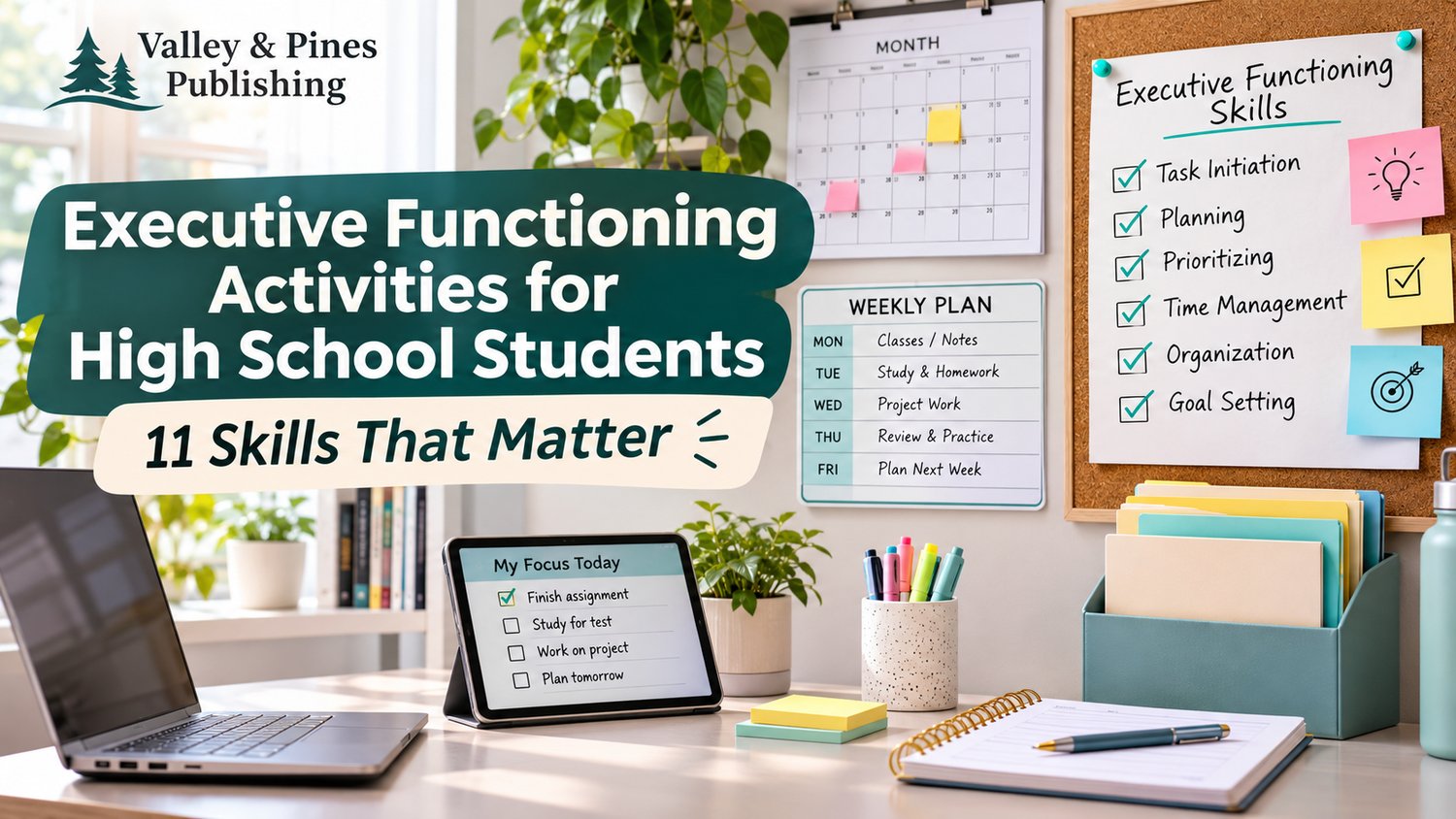
Executive Functioning Activities for High School Students: 11 Skills That Matter
A student can understand an assignment, know when it is due, and have every resource needed to complete it — yet still struggle to begin.
Another student may start assignments easily but forget deadlines, underestimate how long work will take, or become overwhelmed when several responsibilities compete for attention.
These are different executive functioning challenges, and they need more than the same generic advice to get organized.
For teachers working with high school students, the goal is to help teenagers develop practical systems they can use independently in school, employment, and everyday life.
Here are 11 executive functioning skills worth teaching through realistic classroom activities.
1. TASK INITIATION: HELP STUDENTS GET STARTED
One of the most common challenges is knowing what needs to happen but struggling to take the first step.
Instead of telling a student to start their assignment, help them identify the smallest useful action.
For example, a student facing a three-page essay might begin by opening the document, writing the title, and listing three ideas.
A manageable first action can make a large task feel less overwhelming.
Students can practise breaking different responsibilities into realistic starting points.
2. PLANNING: TURN BIG RESPONSIBILITIES INTO ACTIONS
Planning involves more than writing a due date on a calendar.
Students must identify the steps involved, estimate how long they will take, and decide when to complete them.
Try giving students a project due in ten days.
Ask them to create a practical schedule that accounts for classes, other assignments, activities, and unexpected interruptions.
Then change one of the conditions.
Can they adjust their plan without abandoning the entire project?
3. PRIORITIZING: DECIDE WHAT MATTERS FIRST
Students frequently face multiple responsibilities at the same time.
An overdue assignment, an upcoming test, a group project, and a part-time job may all demand attention.
Present a scenario with five competing responsibilities.
Ask students to consider deadlines, consequences, importance, and available time before choosing what to tackle first.
The objective is to develop judgment rather than simply complete tasks in the order they appear.
4. TIME MANAGEMENT: ESTIMATE AND ADJUST
Many teenagers underestimate the time required to complete schoolwork.
An assignment they expect to finish in twenty minutes may take an hour.
Have students predict how long a task will take, record the actual time, and compare the results.
Then ask how they would plan differently next time.
This helps students develop more realistic expectations about their available time.
5. ORGANIZATION: CREATE SYSTEMS STUDENTS CAN MAINTAIN
A complicated organizational system is not necessarily an effective one.
Students need simple routines that work with their responsibilities.
Examples include a consistent assignment location, a weekly materials check, a visible deadline tracker, and a short end-of-day review.
Encourage students to test different approaches and identify which systems they will realistically continue using.
6. WORKING MEMORY: STOP RELYING ON REMEMBERING EVERYTHING
Students may struggle to keep multiple instructions, deadlines, and responsibilities in mind.
External supports can reduce that burden.
Teach students how to create useful checklists, capture instructions, establish reminders, and store important information where they can retrieve it.
Then practise applying these strategies to realistic school and everyday situations.
7. PROCRASTINATION: IDENTIFY WHAT IS GETTING IN THE WAY
Procrastination is not always a matter of laziness.
Students may delay work because they feel uncertain, overwhelmed, distracted, or worried about making mistakes.
Ask students to identify the barrier behind a delayed task.
Then have them choose a practical response, such as breaking the assignment into smaller steps, asking for clarification, or setting a short work interval.
8. MISSING ASSIGNMENTS: BUILD A REALISTIC RECOVERY PLAN
When several assignments are missing, students may struggle to decide where to begin.
A useful recovery activity starts with an honest inventory of outstanding work.
Students identify deadlines, potential consequences, estimated completion times, and available support.
Then they create a realistic 72-hour recovery plan.
The purpose is to turn an overwhelming situation into a manageable sequence of decisions.
9. GOAL SETTING: MOVE FROM INTENTIONS TO ACTION
A goal such as "get better grades" is not particularly useful without a plan.
Students should identify a specific outcome, the actions required, possible obstacles, and a way to measure progress.
For example, a student might choose to submit all assignments on time for two consecutive weeks.
Their plan could include checking the assignment portal daily, recording deadlines, and reviewing progress each Friday.
10. MANAGING OVERWHELM: BREAK DOWN COMPLEX TASKS
Large responsibilities can become difficult to manage when students cannot see a clear path forward.
Teach students to separate a task into smaller actions, identify what they already know, and determine what information or support they still need.
Use realistic situations involving long-term projects, competing commitments, or unexpected changes.
The emphasis should be on choosing the next useful action rather than trying to solve everything at once.
11. DECISION-MAKING: PRACTISE EXECUTIVE FUNCTIONING IN REAL LIFE
Executive functioning is not limited to academic assignments.
Students use these skills when preparing for work, managing appointments, organizing transportation, completing household responsibilities, and balancing personal commitments.
Scenario-based activities allow students to practise decisions before facing the consequences in real life.
Ask students to explain what they would do, why they chose that response, and what they would change if the situation became more complicated.
A COMPLETE EXECUTIVE FUNCTIONING RESOURCE FOR TEACHERS
Teaching executive functioning effectively requires more than one worksheet or one organizational strategy.
Different students need practice with different challenges, and their needs can change over time.
Valley & Pines Publishing offers the Executive Functioning Curriculum Mega Bundle | Activities for Teens, a collection of 11 resources designed for practical, scenario-based instruction.
The bundle includes activities covering:
Task initiation
Planning and prioritizing
Time management
Organization
Working memory and reminders
Procrastination
Missing assignment recovery
Goal setting
Managing overwhelming tasks
Executive functioning reset strategies
100 executive functioning decision scenarios
The resources can be used individually to target specific skills or combined into a broader executive functioning program.
Designed primarily for Grades 9–12, the collection supports high school classrooms, special education, academic support, life skills, advisory, and transition instruction.
EXPLORE THE EXECUTIVE FUNCTIONING MEGA BUNDLE
View the complete 11-resource Executive Functioning Curriculum Mega Bundle on Teachers Pay Teachers:
https://www.teacherspayteachers.com/Product/Executive-Functioning-Curriculum-Mega-Bundle-Activities-for-Teens-17668484
The currently listed bundle price is $86.09 USD. Pricing and availability are subject to change.
THE GOAL IS INDEPENDENCE, NOT PERFECTION
Students do not need perfect planners or complicated systems to develop stronger executive functioning skills.
They need opportunities to recognize challenges, choose strategies, practise decisions, and adjust when their first approach does not work.
When executive functioning instruction focuses on practical actions rather than vague expectations, students can begin building systems that support them in school and beyond.
The goal is not to make every student work the same way.
It is to help each student develop reliable ways to get started, follow through, and recover when plans change.