
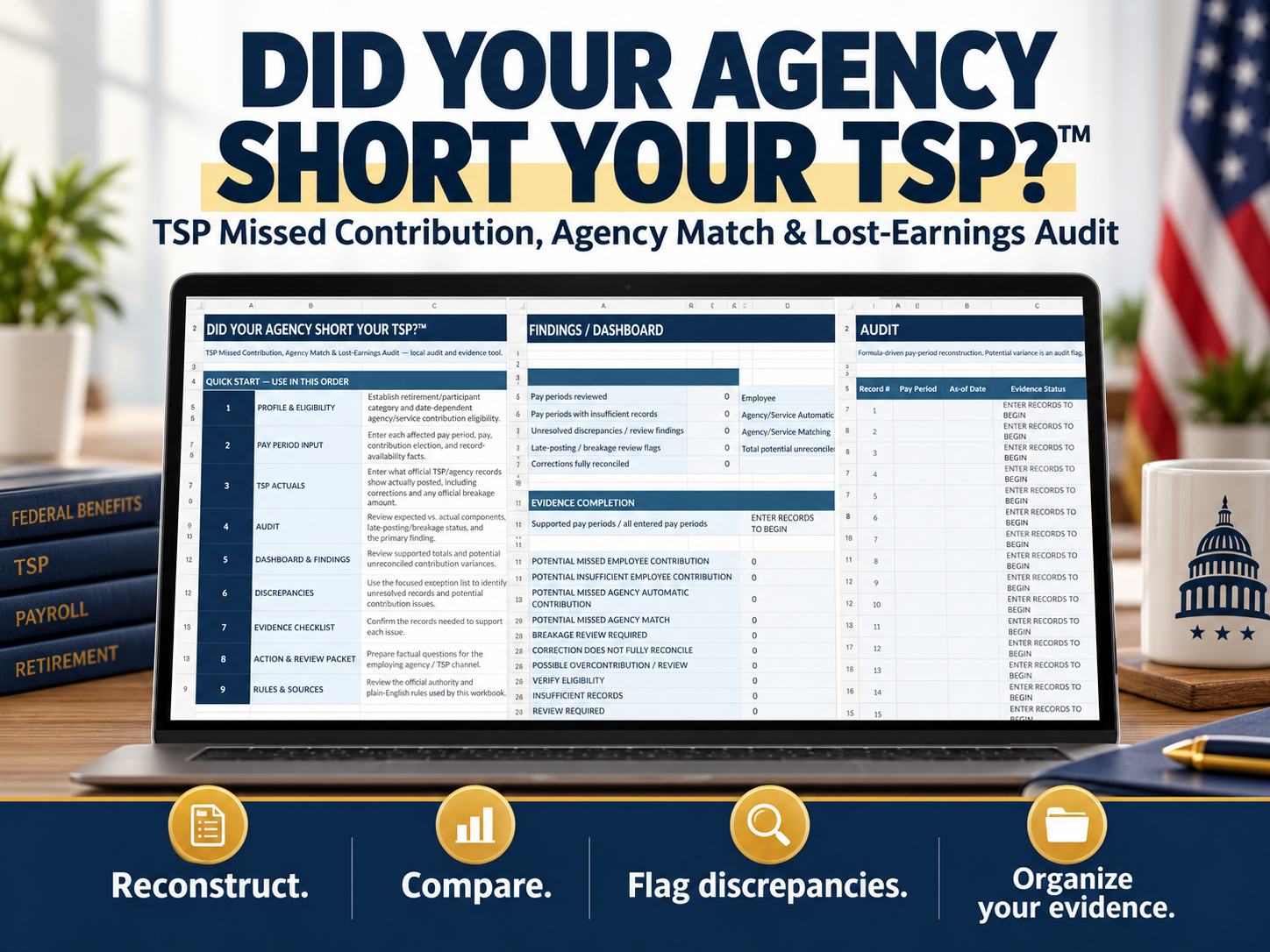
Did Your Agency Short Your TSP?
A TSP account can look normal while still containing contribution problems hidden across individual pay periods.
If a TSP base pay contribution election is invalid, entered incorrectly, or not implemented as elected, the resulting shortfall may affect employee contributions, agency matching contributions, or both.
A contribution election may not have been implemented correctly.
An employee contribution may have been missed or reduced.
Agency Automatic (1%) Contributions or Agency Matching Contributions may not fully reconcile.
A contribution may have been posted late.
A correction may appear in the account without fully resolving the original problem.
And when contributions are posted late enough, there may also be a breakage issue that requires review using official TSP records.
The problem is that these issues are rarely obvious from one account balance.
The most reliable way to investigate them is pay period by pay period.
WHAT SHOULD YOU COMPARE?
A proper TSP contribution audit starts by comparing records from both sides of the transaction.
Useful records can include:
• LES or federal pay statements
• TSP transaction history
• TSP account statements
• contribution election records
• agency payroll records
• corrected pay statements
• agency correspondence
• TSP correction transactions
• official correction notices
For each affected pay period, the goal is to determine:
1. What employee contribution should have been made?
2. What employee contribution was actually made?
3. Was an Agency Automatic contribution applicable?
4. Was Agency Matching applicable?
5. What agency contributions should have been made?
6. What actually reached the TSP account?
7. When was it posted?
8. Was a correction later made?
9. Does that correction fully reconcile the original difference?
10. Is additional evidence or official review still required?
MISSED EMPLOYEE CONTRIBUTIONS
One of the clearest discrepancies occurs when payroll records indicate that a TSP contribution should have been made but the corresponding contribution does not appear correctly in the TSP record.
This can happen because of payroll processing problems, contribution-election issues, coding errors or correction problems.
The important point is not to assume an error from incomplete records.
The expected contribution and the actual contribution should be reconstructed from available evidence before treating the difference as a potential discrepancy.
AGENCY AUTOMATIC CONTRIBUTIONS
Not every TSP participant is entitled to every contribution type.
Agency Automatic contributions depend on the participant's applicable retirement or employment coverage and other official eligibility rules.
That means an audit should establish eligibility before calculating a potential missing contribution.
If eligibility cannot be established from the available records, the proper result is not automatically "missing contribution."
It is a request to verify eligibility.
AGENCY MATCHING CONTRIBUTIONS
Agency Matching Contributions can also be affected when an employee contribution is missed or processed incorrectly.
This creates an important second layer to the audit.
A payroll problem affecting the employee contribution may also affect the amount of agency matching that should have been deposited.
For that reason, reviewing only the employee contribution can miss part of the potential issue.
LATE CONTRIBUTIONS AND BREAKAGE REVIEW
Timing matters.
Current federal rules provide that TSP does not calculate breakage when contributions or loan payments are posted within 30 days of the applicable "as of" date.
When the posting falls outside the applicable window, breakage review may be required.
But an independent spreadsheet should not pretend that it can reproduce the official TSP breakage calculation without the necessary historical TSP data.
The official calculation may depend on information such as historical investment elections, fund share prices, posting dates and applicable "as of" dates.
A responsible audit should therefore identify when breakage review may be required and reconcile an official breakage amount if one has been provided.
It should not invent an estimated entitlement.
CORRECTIONS DO NOT ALWAYS END THE AUDIT
Finding a correction transaction is useful, but it does not automatically mean the problem has been resolved.
The correction should be compared with the original discrepancy.
Questions to ask include:
• Was the full employee contribution restored?
• Was applicable agency money restored?
• Was the correction assigned to the proper pay period?
• Was the transaction posted at the correct time?
• Was official breakage addressed where required?
• Do the corrected totals now reconcile?
If the numbers still do not match, the issue may require additional agency or TSP review.
MISSING RECORDS ARE NOT PROOF OF AN ERROR
A missing document should never automatically become an accusation.
If there is not enough information to determine what should have happened, the appropriate conclusion is that the records are insufficient.
That distinction matters.
A strong audit separates:
• confirmed matching records
• potential discrepancies
• insufficient records
• not-applicable contribution types
• eligibility questions
• late-posting issues
• corrections that reconcile
• corrections that do not reconcile
• issues requiring official review
HOW DID YOUR AGENCY SHORT YOUR TSP?™ HELPS
DID YOUR AGENCY SHORT YOUR TSP?™ is a professional Excel-based TSP contribution audit designed to organize this review pay period by pay period.
The workbook includes:
• Profile and eligibility setup
• Pay-period reconstruction
• TSP actual transaction entry
• Expected-versus-actual contribution comparison
• Employee contribution variance review
• Agency Automatic contribution review
• Agency Matching contribution review
• Late-posting flags
• Breakage-review routing
• Correction reconciliation
• Findings dashboard
• Discrepancy register
• Evidence checklist
• Action & Review Packet
• Official rule and source references
The goal is not to produce an alarming number.
The goal is to build a defensible record showing what should have happened, what actually happened, what does not reconcile and what evidence may still be needed.
If your federal payroll records and TSP transaction history do not line up, reviewing them pay period by pay period can help you identify the specific records and questions you need to raise with your employing agency or the appropriate TSP channel.
DID YOUR AGENCY SHORT YOUR TSP?™ is an audit and evidence-organization tool. It does not provide legal, tax, investment or financial advice and does not establish agency liability or guarantee that money is owed.