
CRDP & CRSC Retroactive Pay: How to Reconcile DFAS and VA Payments Month by Month
A retroactive payment from DFAS or the Department of Veterans Affairs can look simple when it reaches your bank account.
One deposit.
One amount.
One payment date.
But the entitlement behind that deposit may involve months — or even years — of changing military retired pay, VA disability compensation, VA waivers, CRDP eligibility, CRSC awards and effective dates.
That is why reviewing only the final lump-sum payment can miss the real question:
Did every entitlement month reconcile correctly?
VA payment reconciliation can also matter when prior separation pay is being recouped. Our VA separation pay recoupment guide explains how to review the amount withheld against the underlying payment and service record.
WHY RETROACTIVE MILITARY PAY CAN BECOME COMPLICATED
A retroactive period may cross multiple changes, including:
• VA disability-rating increases
• VA compensation-rate changes
• Dependency changes
• Military retired-pay COLAs
• CRSC award changes
• CRDP eligibility changes
• CRDP / CRSC election changes
• Chapter 61 limitations
• Reserve or Guard retirement eligibility
• Different DFAS and VA payment dates
A payment issued today may therefore relate to entitlement that arose years earlier.
The payment date and the entitlement month are not the same thing.
CRDP AND CRSC ARE NOT THE SAME BENEFIT
Concurrent Retirement and Disability Pay — CRDP — and Combat-Related Special Compensation — CRSC — operate differently.
CRDP generally restores military retired pay that would otherwise be reduced because of the VA disability-compensation waiver.
It should not automatically be treated as a separate additional payment on top of retired pay.
CRSC is a separate compensation program based on an official combat-related disability determination from the retiree’s Branch of Service.
A retiree may qualify for both programs, but CRDP and CRSC should not simply be added together for the same entitlement period.
For a historical reconciliation, the important question is:
Which program governed each month?
THE VA WAIVER MATTERS
Military retired pay and VA disability compensation interact through the VA-waiver rules.
Depending on the retiree and the entitlement involved, the historical record may include:
• Gross military retired pay
• VA compensation
• VA waiver or offset
• CRDP restoration
• Residual retired pay
• CRSC compensation
Looking only at a bank deposit can make these components difficult to separate.
That is particularly important when determining whether a difference represents an actual entitlement issue, an authorized deduction, a timing difference or simply the way concurrent receipt was reflected on the retiree’s account.
DFAS AND VA MAY BE RESPONSIBLE FOR DIFFERENT PORTIONS
A retroactive adjustment does not necessarily come entirely from one agency.
DFAS may calculate or issue one portion of the adjustment while VA issues another.
That means a proper reconciliation should keep the two agencies separate:
EXPECTED FROM DFAS
EXPECTED FROM VA
ACTUAL FROM DFAS
ACTUAL FROM VA
Combining everything into one “total received” number can conceal which side of the record does not reconcile.
EFFECTIVE DATE IS NOT THE SAME AS PAYMENT DATE
Suppose VA issues a rating decision in 2026 with an effective date in 2024.
Those dates represent different events.
There may be:
• An entitlement effective date
• A VA decision date
• A DFAS audit date
• A VA payment date
• A DFAS payment date
The historical audit should therefore follow the entitlement period, not simply the date money arrived.
WHY CRSC AWARD HISTORY MATTERS
CRSC percentages can change.
A reconsideration or later award letter may apply a different combat-related percentage to only part of the historical period.
The newest CRSC percentage should not automatically be applied backward across every prior month.
The official Branch-of-Service CRSC award and its effective dates control the historical record.
VA disability percentage and CRSC percentage should also never be assumed to be identical.
CHAPTER 61 CASES REQUIRE EXTRA CARE
Chapter 61 disability retirement can introduce additional limitations.
Depending on the retiree’s service history and circumstances, concurrent-receipt calculations may require consideration of:
• Disability retired pay
• Years of qualifying service
• Hypothetical longevity retired pay
• VA compensation
• Residual retired pay
• CRDP limitations
• CRSC limitations
A standard longevity-retirement calculation should not simply be applied to every Chapter 61 retiree.
RESERVE AND GUARD RETIREES CAN HAVE ADDITIONAL DATE QUESTIONS
Reserve and Guard retirees may also have retirement-age or reduced-retirement-age considerations.
For some cases, the date of disability retirement is not automatically the date concurrent retirement benefits can begin.
Official retirement records and Branch-of-Service information may be necessary before a historical entitlement period can be determined reliably.
THE SIX-YEAR RETROACTIVE LIMIT CAN MATTER
CRSC retroactive payments can also be affected by the applicable six-year barring rule.
This is another reason not to assume that the earliest disability effective date automatically equals the earliest payable CRSC date.
The correct result can depend on the official award history and other case-specific dates.
If the supporting records are incomplete, the correct conclusion may simply be:
SIX-YEAR LIMIT REVIEW REQUIRED
rather than automatically treating the period as unpaid.
MISSING RECORDS ARE NOT PROOF OF AN UNDERPAYMENT
This distinction is critical.
If a DFAS Retiree Account Statement is missing, that does not prove DFAS failed to pay.
If a VA payment record is unavailable, that does not prove VA owes money.
And if the CRSC award history is incomplete, the correct historical CRSC amount may not yet be determinable.
A strong audit separates:
• Numerical discrepancies
• Missing evidence
• Eligibility uncertainty
• Authorized deductions
• Timing differences
• Actual payment differences
That makes the findings more defensible and much easier to review.
RECONSTRUCT THE PERIOD MONTH BY MONTH
For complex retroactive cases, the most useful approach is to reconstruct each entitlement month using the best available official records.
That can include:
• DFAS Retiree Account Statements
• DFAS CRSC statements
• DFAS retroactive audit letters
• VA Rating Decisions
• VA Award Letters
• VA payment history
• CRSC Award Letters
• CRSC reconsideration letters
• Retirement orders
• Reserve retirement documents
• Historical gross retired-pay records
• Official payment records
Each month can then be compared against what DFAS and VA actually paid.
That makes it possible to identify precisely which periods reconcile and which still require verification.
A FORENSIC WORKBOOK FOR THIS EXACT JOB
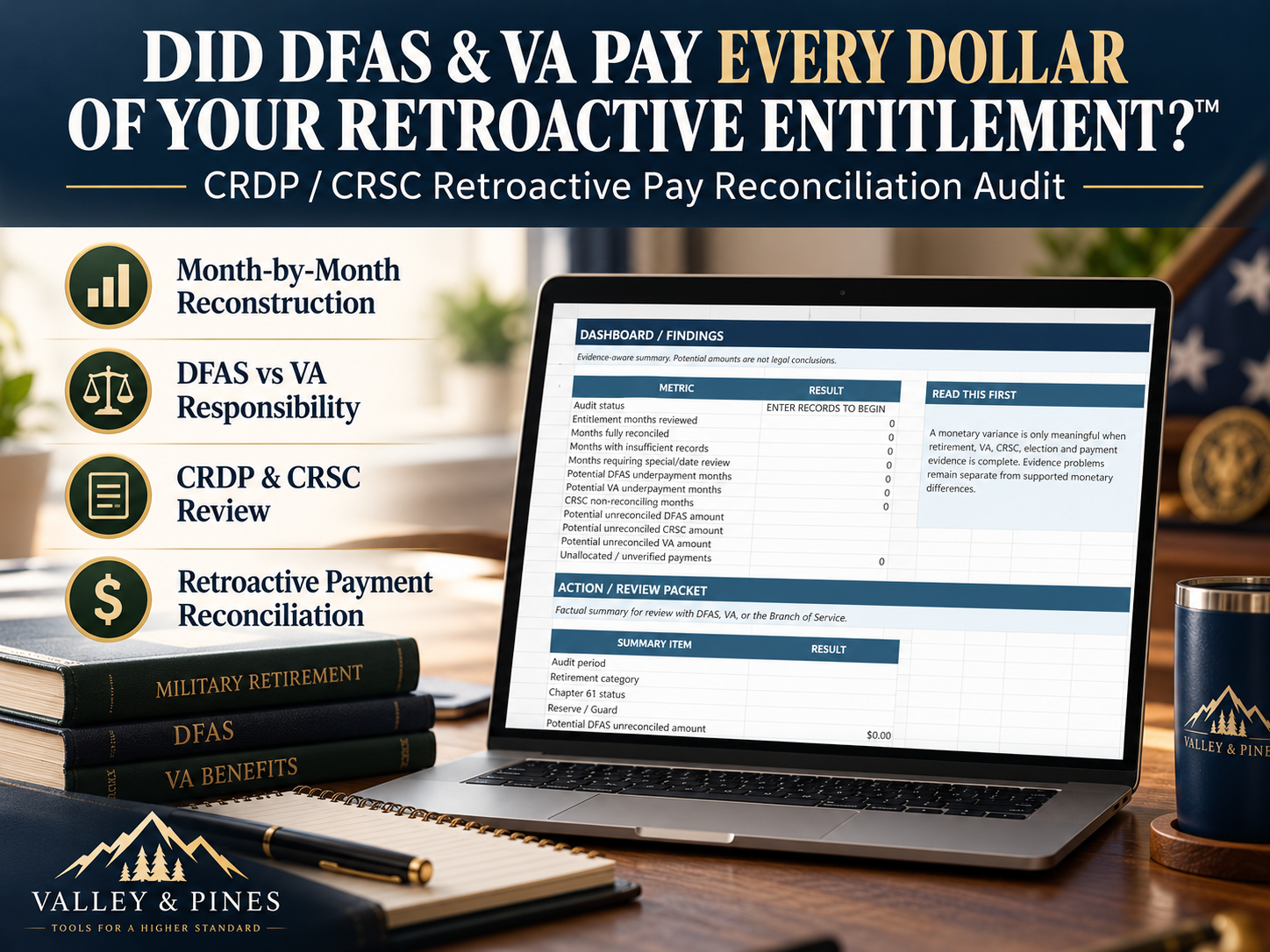
Valley & Pines created DID DFAS & VA PAY EVERY DOLLAR OF YOUR RETROACTIVE ENTITLEMENT?™ for retirees who need a structured way to reconstruct this record.
The CRDP / CRSC Retroactive Pay Reconciliation Audit includes:
• Retiree Profile
• Awards & Eligibility
• VA History
• Retired Pay History
• CRDP / CRSC History
• Payments Received
• Monthly Audit
• Dashboard / Findings
• Discrepancy Register
• Evidence Checklist
• Action / Review Packet
• Rules & Sources
The workbook separates DFAS and VA responsibility and uses evidence-aware findings rather than automatically treating incomplete records as proof of an underpayment.
It is designed to help answer one practical question:
For every month in the retroactive period, what should the records show, what was actually paid, and which months still fail to reconcile?
Review the CRDP / CRSC Retroactive Pay Reconciliation Audit here:
IMPORTANT
This workbook is an evidence-organization and reconciliation tool.
It does not determine whether a disability is combat related, replace an official DFAS or VA audit, provide individualized legal or tax advice, or guarantee recovery of any amount.
Your records remain with you. Valley & Pines does not receive or store your personal DFAS, VA or military records.