
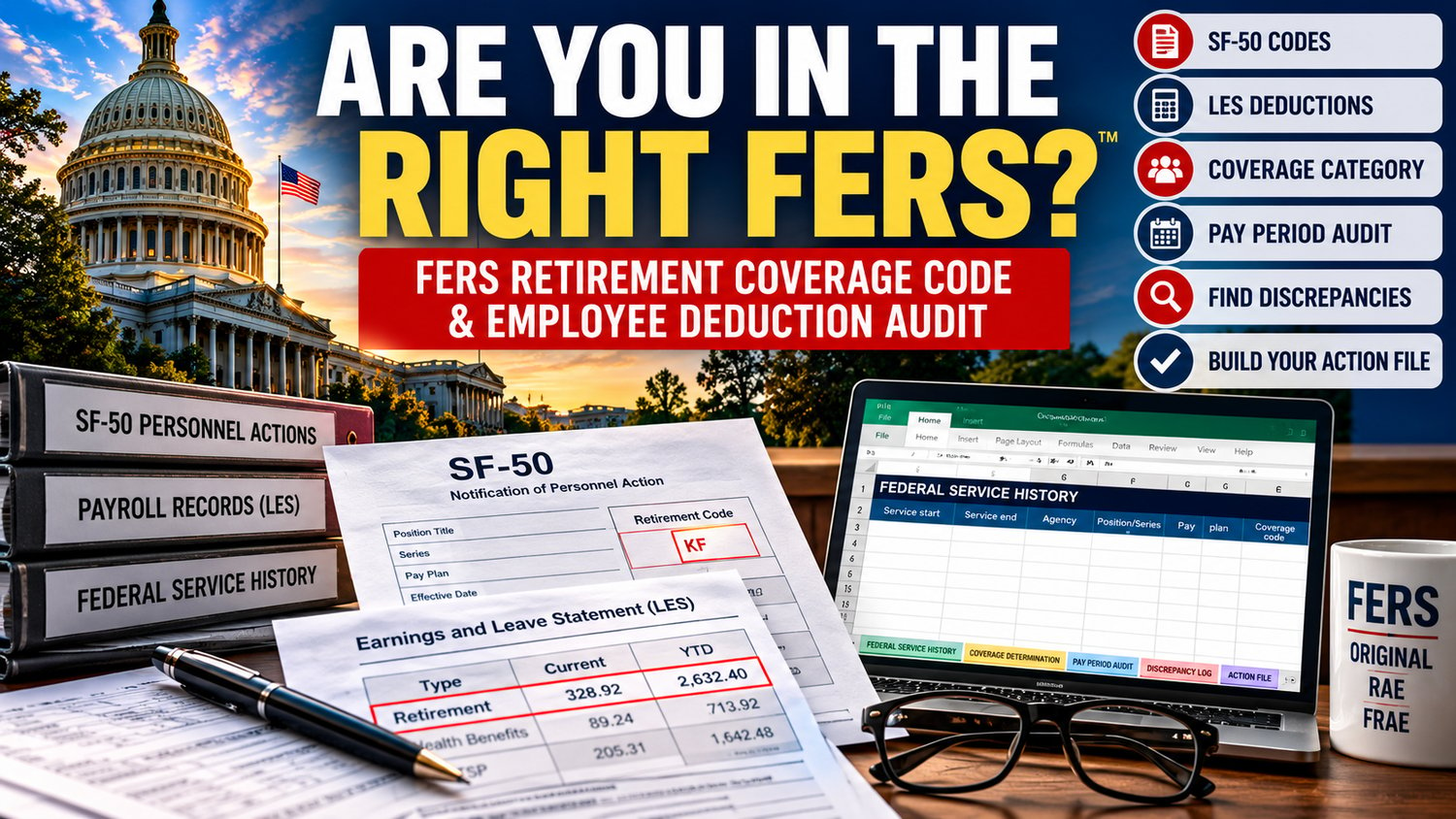
ARE YOU IN THE RIGHT FERS?
Most Federal employees know they are covered by FERS.
Far fewer know that there are different FERS contribution categories — and that being placed in the wrong category can affect the retirement deductions taken from every paycheck.
For many employees, the key question is not simply:
“Am I in FERS?”
It is:
“Am I in Original FERS, FERS-RAE, or FERS-FRAE — and are my SF-50 and payroll deductions consistent with that history?”
That distinction matters.
ORIGINAL FERS, FERS-RAE AND FERS-FRAE
For regular FERS employees, the employee contribution rates commonly associated with these categories are:
Original FERS — 0.8%
FERS-RAE — 3.1%
FERS-FRAE — 4.4%
Certain special retirement categories use higher employee contribution rates.
The date you were hired matters — but your most recent hire date does not necessarily tell the whole story.
Prior Federal civilian service, earlier FERS coverage, service around the 2012 and 2013 transition dates, certain short breaks in service and other special circumstances can affect which FERS category appears applicable.
That is why simply looking at the year on your latest SF-50 may not be enough.
YOUR RETIREMENT CODE MATTERS
Federal personnel and payroll records use retirement coverage codes.
Examples include:
K / KR / KF — Regular FERS
L / LR / LF — Air Traffic Controller
M / MR / MF — Special-category FERS
N / NR / NF — Reserve Technician
O / OR / OF — Customs and Border Protection enhanced coverage
Within these supported code families:
No suffix generally represents Original FERS.
R generally represents FERS-RAE.
F generally represents FERS-FRAE.
Your SF-50 may show one retirement code while your Leave and Earnings Statement shows payroll deductions associated with a particular contribution rate.
Those records should make sense together.
TWO DIFFERENT PROBLEMS CAN OCCUR
A retirement coverage problem and a payroll deduction problem are not necessarily the same thing.
COVERAGE-CODE MISMATCH
Your employment history may indicate that one FERS category appears applicable, while the retirement code recorded on your SF-50 or payroll record reflects another.
For example, your record might appear consistent with FERS-FRAE while the recorded retirement code is associated with FERS-RAE.
PAYROLL-DEDUCTION MISMATCH
Your retirement code may appear correct, but the actual amount deducted from your pay may not reconcile with the expected employee contribution rate.
These situations need to be examined separately.
A correct code does not automatically prove that every payroll deduction was correct.
And a deduction that mathematically matches the recorded code does not automatically establish that the underlying coverage code was correct.
WHAT SHOULD YOU REVIEW?
A useful FERS record audit may include:
• Your Federal civilian employment history
• SF-50 effective dates
• Retirement codes shown on SF-50s
• Retirement codes shown on LES/payroll records
• Prior FERS coverage
• Prior Federal civilian service
• Service around December 31, 2012
• Service around December 31, 2013
• Breaks in Federal civilian service
• Retirement-covered basic pay
• Actual employee retirement deductions
• Retroactive payroll adjustments
• Supporting personnel and payroll documents
Certain situations can require additional review, including LWOP, USERRA reemployment, FECA/OWCP periods, prior CSRS or CSRS Offset civilian service, FERS elections and incomplete appointment histories.
MILITARY SERVICE IS AN IMPORTANT DISTINCTION
Military service can be extremely important to Federal retirement planning.
However, active-duty military service by itself should not simply be counted as Federal civilian service when evaluating the five-year civilian-service exception used in certain FERS coverage determinations.
That distinction can matter when reconstructing an employee’s history.
WHAT IF THE NUMBERS DO NOT MATCH?
A discrepancy does not automatically mean your agency made an error or that you are entitled to a refund.
It means the record deserves review.
Possible findings may include:
APPEARS CONSISTENT
POSSIBLE COVERAGE-CODE MISMATCH
POSSIBLE OVER-DEDUCTION
POSSIBLE UNDER-DEDUCTION / POTENTIAL CONTRIBUTION EXPOSURE
INSUFFICIENT RECORDS
SPECIAL CASE — MANUAL REVIEW REQUIRED
Under-deductions should not automatically be viewed as good news.
If too little was collected, the issue may create future contribution or debt exposure that should be clarified before retirement.
BUILD THE EVIDENCE FILE BEFORE YOU NEED IT
The best time to discover a retirement-record discrepancy is not when you are already trying to retire.
Gathering the relevant SF-50s, LES records and employment history ahead of time gives you something concrete to take to your agency HR, benefits or payroll office.
DID THEY PUT YOU IN THE RIGHT FERS?™ was built to help organize that review.
The Excel workbook reconstructs your Federal civilian service history, screens Original FERS vs FERS-RAE vs FERS-FRAE, compares supported retirement codes, audits employee deductions by pay period and creates a discrepancy/action file for periods that may need further review.
It does not make an official OPM retirement coverage determination.
It helps you identify the questions your records may be telling you to ask.
Check the record.
Check the code.
Check the deductions.
And identify potential problems before retirement.