
The 2025–26 Civil Rights Data Collection can become complicated long before a district reaches the final submission stage.
The challenge is rarely one individual data point.
It is managing the entire process across reporting schools, departments, source systems, data requests, changing requirements, internal reviews, validation results, corrections and sign-offs — while still knowing what remains unfinished.
For district teams responsible for CRDC reporting, that creates a deceptively difficult question:
**Are we actually ready for final authorized review?**
## CRDC Is a Data Collection — But It Is Also a Project
A district may have information coming from student information systems, special education records, human resources, discipline systems, program staff, school administrators and other internal sources.
That means successful CRDC preparation requires more than collecting numbers.
District teams also need to know:
- Which reporting schools are complete
- Which requirements still need attention
- Where each data element originates
- Who owns each reporting area
- Which data requests are outstanding
- Which 2025–26 changes have been reviewed
- Which zeros, blanks or NS responses require review
- Which issues remain unresolved
- Which federal validation errors or warnings require attention
- Whether corrections have been completed
- Which internal reviews and sign-offs remain outstanding
When those controls live in separate emails, notes, spreadsheets and departmental workflows, it becomes much harder to see the district's true readiness.
## The Dangerous Part Is What You Cannot See
An unfinished CRDC item is manageable when everyone knows it exists.
The greater operational risk is an item that appears complete but still has an unresolved dependency.
A reporting area may have been received but not reviewed.
A validation problem may have been addressed in the submission but not corrected in the underlying source.
A school may appear complete while another required review remains open.
A zero may represent a confirmed zero — or simply data that has not yet been collected.
Those distinctions matter.
That is why districts benefit from treating CRDC preparation as a controlled workflow rather than simply a collection of forms and reports.
## Build One Source of Operational Truth
A strong CRDC control process should make five things immediately visible:
**What is required.**
**Who owns it.**
**Where the information comes from.**
**What still needs attention.**
**Whether the district is ready to move forward.**
That visibility becomes increasingly important as the reporting process moves from collection into validation, corrections and final internal review.
Leadership should not need to reconstruct the district's status from dozens of emails or ask multiple departments for updates.
The answer should already be visible.
## Pay Special Attention to 2025–26 Changes
Every reporting cycle deserves a deliberate change-control review.
Rather than assuming last cycle's process can simply be repeated, districts should identify applicable changes, determine which internal processes or source systems are affected, assign responsibility and document that the change has been reviewed.
That creates a defensible operational trail and reduces the chance of discovering an overlooked change late in the process.
## Treat Zeros, Blanks and NS as Decisions
Zeros and other allowable responses should not become convenient placeholders for information that has not yet been investigated.
District teams need a way to distinguish between a confirmed response and an unresolved data question.
Documenting those decisions creates another layer of control before final review.
## Federal Validation Is Not the End of the Workflow
Validation results can reveal errors, warnings or inconsistencies that require investigation.
But correcting the immediate submission is only part of the job.
District teams should also determine whether the underlying source needs correction so the same issue does not simply return during the next reporting cycle.
That is the difference between fixing a submission and improving the process that produced it.
## Know Your Blockers Before Final Review
Before a district moves toward final authorized review, it should be able to identify outstanding blockers immediately.
Examples may include:
- Incomplete required reporting areas
- Unresolved critical issues
- Outstanding validation items
- Open corrections
- Incomplete required sign-offs
- Unreviewed reporting-cycle changes
- Unresolved Zero / Blank / NS decisions
A readiness process should fail closed: unresolved critical controls should remain visible rather than allowing the project to appear complete simply because most tasks are finished.
## A Command Center for the 2025–26 CRDC Process
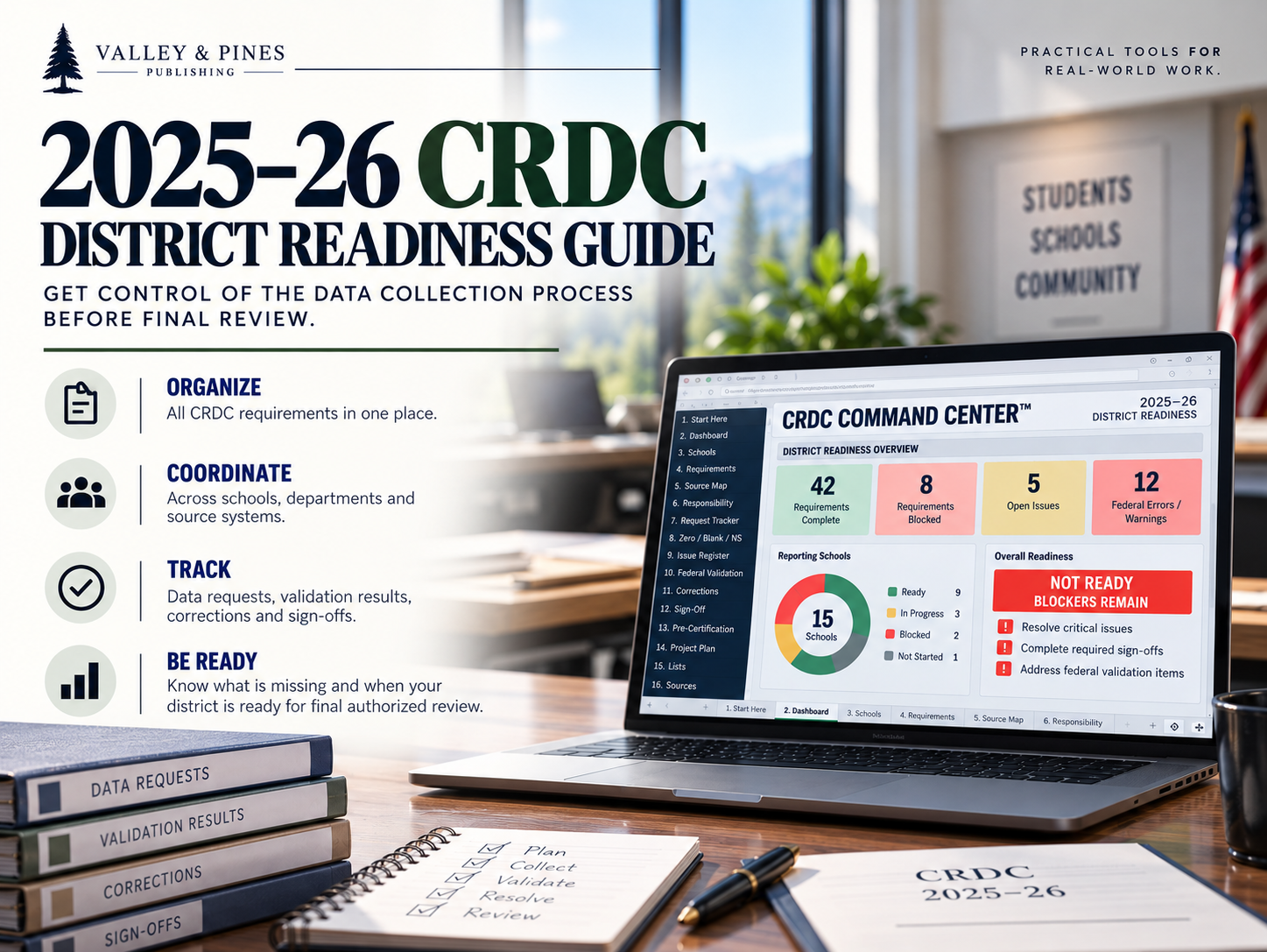
Valley & Pines Publishing developed **CRDC COMMAND CENTER™ — 2025–26 District Readiness, Collection & Certification Control System** to provide districts with one operational control layer around the CRDC process.
The protected Excel system includes a district readiness dashboard, school control, master requirement tracking, source mapping, responsibility management, data-request tracking, 2025–26 change control, Zero / Blank / NS review, issue management, federal validation tracking, correction control, internal sign-offs, pre-certification readiness and an automatic project plan.
It is designed to answer one central operational question:
**What still stands between our district and final authorized review?**
CRDC COMMAND CENTER™ does not replace official CRDC resources, federal validation, certification, authorized district review or the district's responsibility for its submission.
Instead, it provides the organizational control layer that helps district teams manage everything happening around those official processes.
**Know what is missing. Know who owns it. Know what needs attention. Know when your district is ready for final authorized review.**
Learn more about CRDC COMMAND CENTER™ from Valley & Pines Publishing.
## Choose the Right License for Your District
CRDC COMMAND CENTER™ includes the complete 2025–26 district readiness, collection and control system at every license level.
Licensing is based on the number of CRDC reporting schools in your LEA:
**Small LEA License — 1–5 reporting schools — $399**
**District License — 6–20 reporting schools — $599**
**Large District License — 21–50 reporting schools — $899**
Every license includes the complete protected CRDC COMMAND CENTER™ workbook. The difference is the authorized district-size license, not the features included.