



BEFORE YOU ENROLL™ — Power Engineering.
Before you pay tuition, make sure the course actually leads to the Power Engineering certificate you want.
BEFORE YOU ENROLL™ — Power Engineering helps Canadian Fourth Class / Class 4 candidates compare the full route to certification — not just the route into a course.
Passing theory or completing an online course does not automatically satisfy the operating-experience requirements needed for certification.
This workbook helps you compare the course, plant-time, approved lab, full-time program and jurisdiction-specific options before you commit your money.
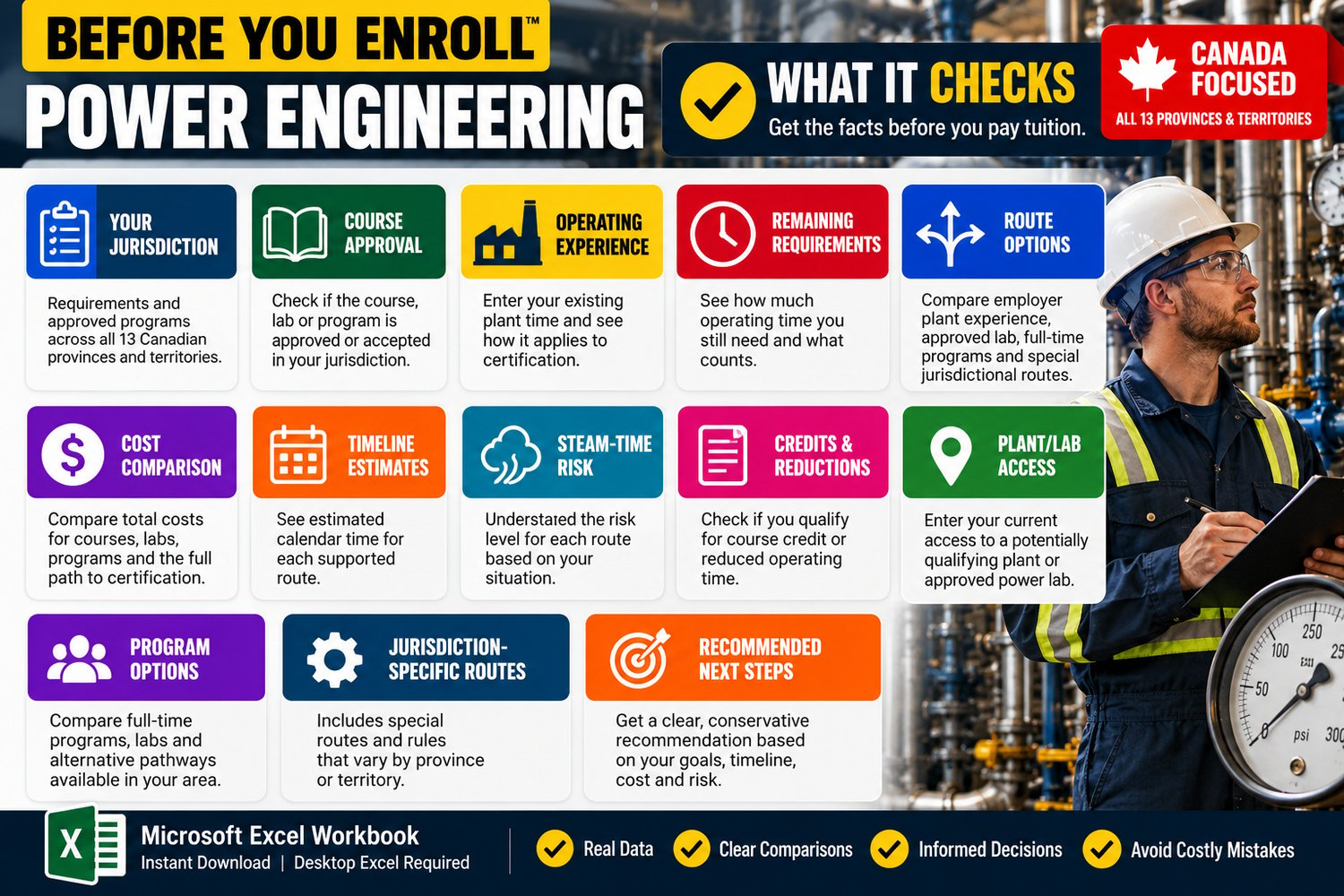
WHAT IT HELPS YOU CHECK
• Your province or territory
• Current access to potentially qualifying plant experience
• Qualifying operating time already documented
• Relevant pressure-equipment experience
• Process-operator experience
• Existing Fifth Class or related credentials
• Mechanical engineering or marine-engineering pathways where applicable
• The exact Fourth Class course you are considering
• Whether that course is currently approved or accepted
• Course cost and duration
• Whether study can overlap with qualifying work
• Approved power-lab availability and accepted hours
• Full-time program options
• Whether a program actually includes accepted operating experience
• Special jurisdiction-specific routes
• Remaining operating-time requirements
• Estimated route cost
• Estimated calendar time
• Steam-time / operating-experience risk
• Fastest supported route
• Cheapest supported route
• Lowest-risk supported route
• Recommended route based on your stated priority
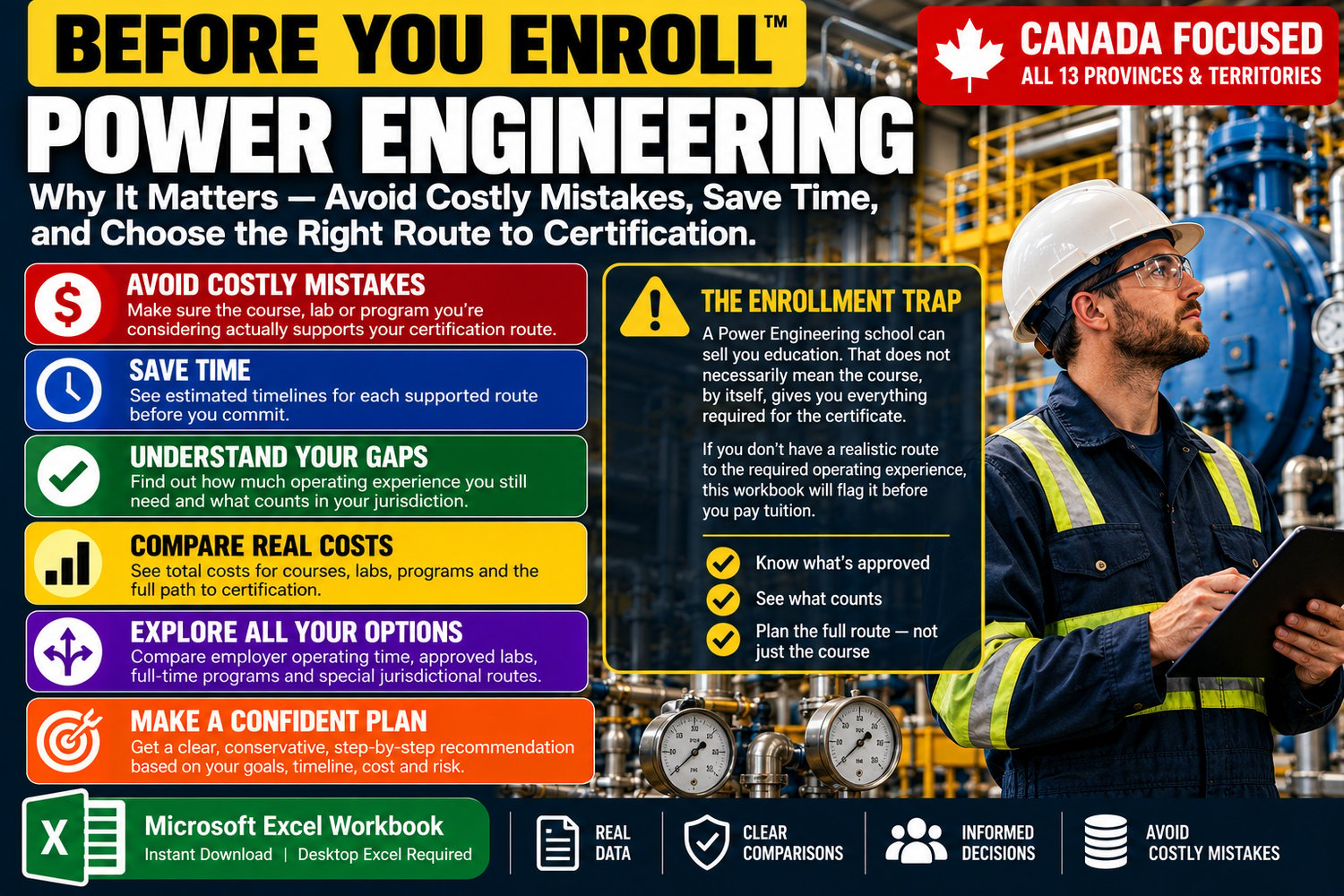
THE ENROLLMENT TRAP
A Power Engineering school can sell you education.
That does not necessarily mean the course, by itself, gives you everything required for the certificate.
If your jurisdiction still requires qualifying operating experience, the workbook will not pretend that a theory course solves that requirement.
If you do not currently have a realistic route to the required plant time, lab experience, approved program experience or regulator-confirmed alternative, the workbook can flag that before you pay tuition.
HOW IT WORKS
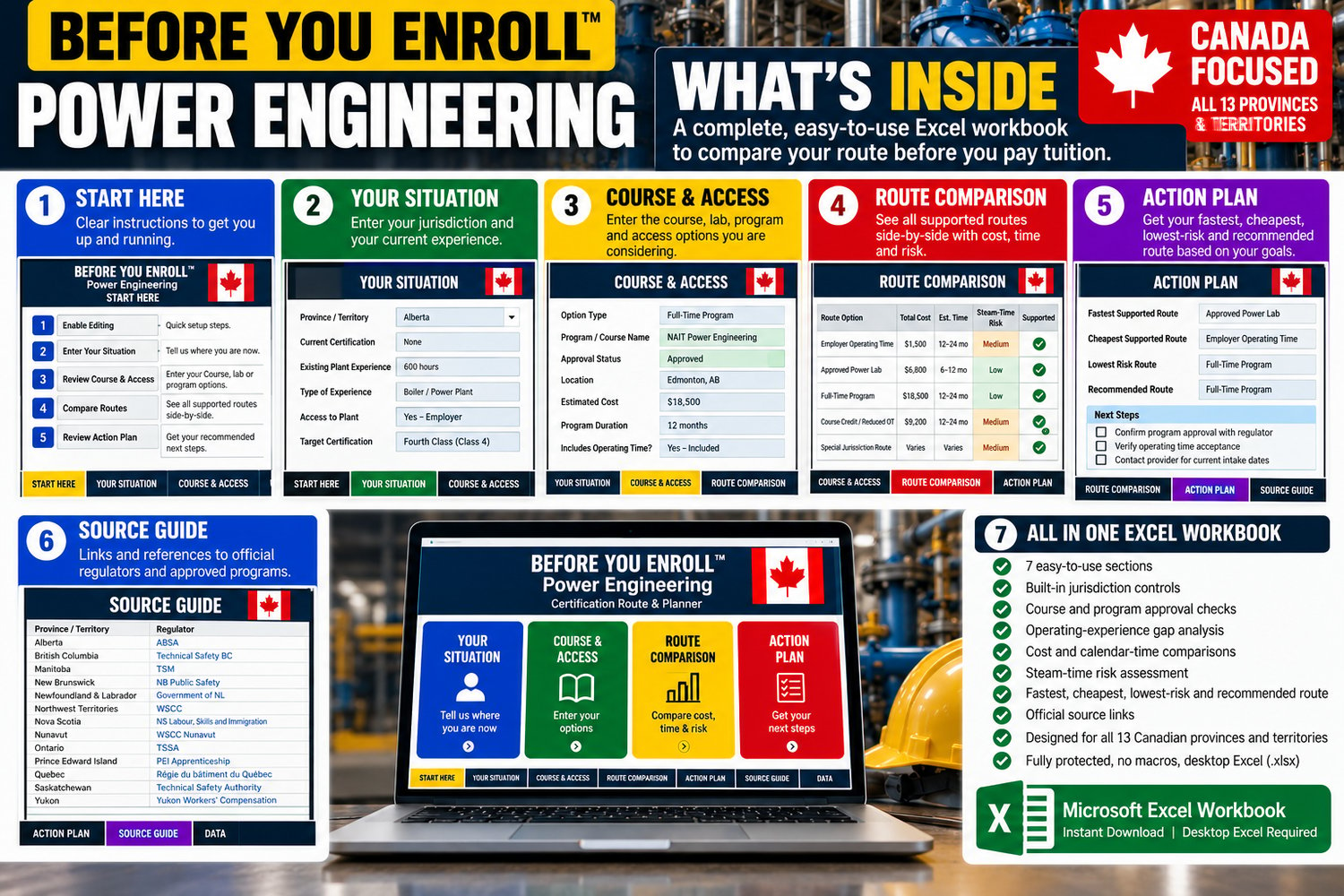
Start with YOUR SITUATION.
Enter the jurisdiction where you intend to certify, the qualifying experience you already have and whether you currently have access to a potentially qualifying plant.
Then use COURSE & ACCESS to enter the actual course, lab or full-time program you are considering, including its approval status, estimated cost, duration and experience component.
ROUTE COMPARISON evaluates the supported pathways side-by-side.
It shows remaining operating time, steam-time risk, planning cost, estimated calendar time, source references and the recommended next action for each route.
ACTION PLAN then identifies the fastest supported route, cheapest supported route, lowest steam-time-risk route and recommended route based on your stated priority.
If there is no safe supported route under the facts entered, it tells you that instead of forcing a recommendation.
CANADA COVERAGE
The workbook includes planning logic across all 13 Canadian provinces and territories.
Because certification rules and approved programs vary by jurisdiction, some situations are intentionally routed to regulator review rather than guessed.
ROUTE FAMILIES
• Employer operating-time route
• Approved power-lab route
• Approved full-time program route
• Course-credit / reduced operating-time route
• Special jurisdiction-specific route
INCLUDED
• Protected Microsoft Excel workbook (.xlsx)
• START HERE instructions
• YOUR SITUATION assessment
• COURSE & ACCESS planner
• ROUTE COMPARISON dashboard
• ACTION PLAN
• Official SOURCE GUIDE
• Built-in jurisdiction controls
• Course and program approval checks
• Operating-experience gap analysis
• Cost and calendar-time comparisons
• Conservative regulator-review routing
IMPORTANT
This is a decision-support and enrollment-planning tool.
It does not guarantee admission, examination eligibility, operating-experience acceptance, certification eligibility, employment or regulator approval.
A school admitting you to a program does not necessarily mean you have satisfied every certification requirement.
Power Engineering requirements, approved courses, accepted operating experience and regulator rules can change.
Always verify the current requirements with the applicable provincial or territorial Power Engineering regulator and the specific approved program or provider before paying tuition.
Canada-focused.
Desktop Microsoft Excel required.